Make Disciples…!

The primary goal of Reaching Africa’s Unreached  is to come alongside the church in North Uganda, South Sudan, Northeastern D.R. Congo, and Lord willing at some point even regions north of these countries in “making disciples”. I appreciate and concur with Matt Capps’ understanding of discipleship. As J.I. Packer notes:

“Discipleship involves “grounding and growing God’s people in the gospel and its implications for doctrine, devotion, duty, and delight”

Pray with us that we will be faithful in “making disciples”!

——————-

Make Disciples…

One of the purposes of Cross is to encourage people to obey Christ’s call to make disciples of all nations, even the most difficult places. However, as we seek to make disciples, we need to be clear on what discipleship is. Eric Geiger’s interview with Matt Capps addresses this very issue.

 ————————————–

Discipleship is such a broad term, often a junk-drawer term that has been used to describe many things. How do you define it?

The term discipleship is somewhat convoluted in today’s church. I’ve seen churches call everything from bible classes, financial courses, theology groups, marriage seminars, and speculative classes on the end times, ‘discipleship’. Certainly, discipleship involves having a biblical understanding of every aspect of life. However, calling everything done under the auspices of the local church ‘discipleship’ is unhelpful at best. When Jesus called the twelve to make disciples, baptize them, and teach them to observe all he commanded them, I doubt he had in mind what most churches call discipleship today. (see Matthew 28:19-20)

The word translated ‘disciple’ in the New Testament communicates the idea of a ‘learner’. A Christian disciple is one who learns the good news of the gospel and applies it to all of life. If you read through all that Jesus commanded the disciples you will find both gospel proclamation and kingdom demonstration. That is, teaching on the Scriptures and application of those teachings. Discipleship should be gospel-centered, word focused, and mission oriented. So, what is discipleship? To use the words of J.I. Packer, discipleship involves “grounding and growing God’s people in the gospel and its implications for doctrine, devotion, duty, and delight” (Grounded in the Gospel, 29). Discipleship is the intentional passing on of the biblical faith.

Moreover, disciples are not merely learners but fruit-bearing disciple-makers; they multiply themselves. (Acts 20:26-35; 2 Timothy 2:2) Those who follow Jesus are called and charged to be people who, having themselves learned, now reach out to teach what they have learned. This involves both formal and informal discipleship. Formal discipleship would include bible teaching and doctrinal instruction, what the church once called catechesis. (Jeremiah 6:16; Galatians 6:6) While informal discipleship would be intentional gospel centered encouragement and accountability in more intimate relationships. (Deuteronomy 6:6-7)


In terms of discipling new believers, what is of chief importance?

A new believer needs to understand the gospel first and foremost. What is the good news, what does it means for me, and why does it matter? And honestly, this process of understanding and applying the gospel will last a lifetime. So, of central importance is grasping the gospel. The initial steps of discipleship with a new believer might be more informal, almost like craftsmanship. It takes time, energy, patience, and skill to walk a new believer through the gospel and its implications, applying it to every area of life.

At the same time, I also think that new believers need to be involved in the formal process of discipleship, again, it used to be called catechesis. While the modern church rarely uses the word catechesis, we often engaged in catechesis training, which is simply doctrinal instruction. This involves spiritual, moral, and theological foundations that can help mature a young believer. Many old Saints from church history have argued that a faithful catechesis was absolutely essential to the healthy continuance of Christ’s church. In pastoral ministry I gave much thought to teaching the essentials of the Christian faith for the maturity of the body. Out of this time of study I developed five courses designed to be taught and discussed in both formal and informal settings.

  • Gospel – The gospel in its simplicity and depth.
  • Story – The story of redemption of which the gospel is the climax. (Biblical Theology)
  • Theology – The doctrines of the faith that conform to the gospel. (Systematic Theology)
  • Community – The power in the gospel that flows from our relationship with God and to others. (Ecclesiology and Biblical Counseling)
  • Mission – The manner of living that conforms to the truth of the gospel. (Missions, Missional Living, Ethics, and Culture)

These courses charted out with an end goal in mind, as not to perpetuate the continual learner but to train and equip every person for fruitful personal ministry. The end aim of these courses is to fully equip our people with essential theological understanding so that they can minister with discernment within their spheres of influence. I wrote and taught these classes with the new believer in mind. The initial question that set everything into motion was, what are the essential things I want every member of this church to believe and understand? After several semesters of teaching the courses, it was encouraging to see other church members who had completed the courses teaching them alongside me and the other pastors.


When thinking or training on discipleship, what passages are anchor passages for you? 

The Apostle Paul charged the leaders in the Ephesian church to “equip the saints for the work of ministry, for building up the body of Christ, until we all attain to the unity of the faith and of the knowledge of the Son of God, to mature manhood” (4:12). God has gifted His church with pastors, elders, and leaders with various gifts who are called to equip the church body to do the work of ministry (Ephesians 4:11). Notice Paul’s words, equip the saints for ministry.

Too often pastors operate as if they are the only ones capable of ministry. This has been called the professionalization of the ministry. However, it seems that Paul had a different ministry philosophy in mind. I think Michael Green captures this idea in his classic work Evangelism in the Early Church:

“It would be a gross mistake to suppose that the apostles sat down and worked out a plan of campaign: the spread of Christianity was, as we have seen, largely accomplished by informal missionaries, and must have been to a large extent haphazard and spontaneous.”

In other words, ministry was the prerogative of every church member. The ordinary people of the Church saw it as their prerogative. In fact, if one studies church history they will see that Christianity has been supremely a lay movement, spread by informal missionaries. As Green said, “The spontaneous outreach of the total Christian community gave immense [momentum] to the movement from the very outset.”

One of the keys of a multiplying discipleship ministry is intentionality in both informal relationships and formal training structures. All Christians have spiritual gifts that are to be used in ministering to others (1 Cor. 12:7, 11; 1 Pet. 4:10). All training and discipleship should be aimed at these ends, gospel proclamation and kingdom demonstration. In becoming a Christian, each one of us becomes a disciple. As Christians we never stop being disciples. We never reach the point where we no longer require daily discipleship by the gospel word and the gospel community. Moreover, as Christians, we are all called to make disciples

“The Least of These”

Let’s get the right doctrine from the right scripture texts!

———————–

“The Least of These”: An Example of the Right Doctrine from the Wrong Text

 by Justin Taylor

In Matthew 24:35-40, Jesus says: “I was hungry and you gave me food, I was thirsty and you gave me drink, I was a stranger and you welcomed me, I was naked and you clothed me, I was sick and you visited me, I was in prison and you came to me.’ Then the righteous will answer him, saying, ‘Lord, when did we see you hungry and feed you, or thirsty and give you drink? And when did we see you a stranger and welcome you, or naked and clothe you? And when did we see you sick or in prison and visit you?’ And the King will answer them, ’Truly, I say to you, as you did it to one of the least of these my brothers, you did it to me.’”

Craig Blomberg comments:

The majority perspective has understand Jesus’ ‘brothers’ in verse 40 to refer to spiritual kin, as the term (adelphoi) does elsewhere in Matthew in every instance in which biological siblings are not in view (see 5:22-24, 47; 7:3-5; 12:48-50; 18:15 twice, 21, 35; 23:8; 28:10).

The term ‘little ones’, of which ‘the least’ (25:40, 45) is the superlative form, also without exception in Matthew refers to disciples (10:42; 18:6, 10, 14; cf. also 5:19 and 11:11).

This makes the point of Jesus’ teaching closely parallel to Matthew 10:42: Jesus’ itinerant followers (today we might call them Christian missionaries) must be cared for by those to whom they minister. Affording material help to those who preach in the name of Jesus demonstrates acceptance of the missionaries’ message at the spiritual level . . . This view is almost certainly correct.

Today, however, the prevailing interpretation is that Jesus is teaching about the need to help the dispossessed whether or not they are Christian. . . .

This is obviously an important biblical theme, but is far less likely to be the focus of this particular passage, given the consistent meaning of the terms and the larger context of parables focusing on the disciples (24:43-25:46).

—Craig L. Blomberg, Neither Poverty nor Riches: A Biblical Theology of Material Possessions, New Studies in Biblical Theology, ed. D. A. Carson (Downers Grove, IL: IVP, 2000), 126; my emphasis.

Theological Famine!

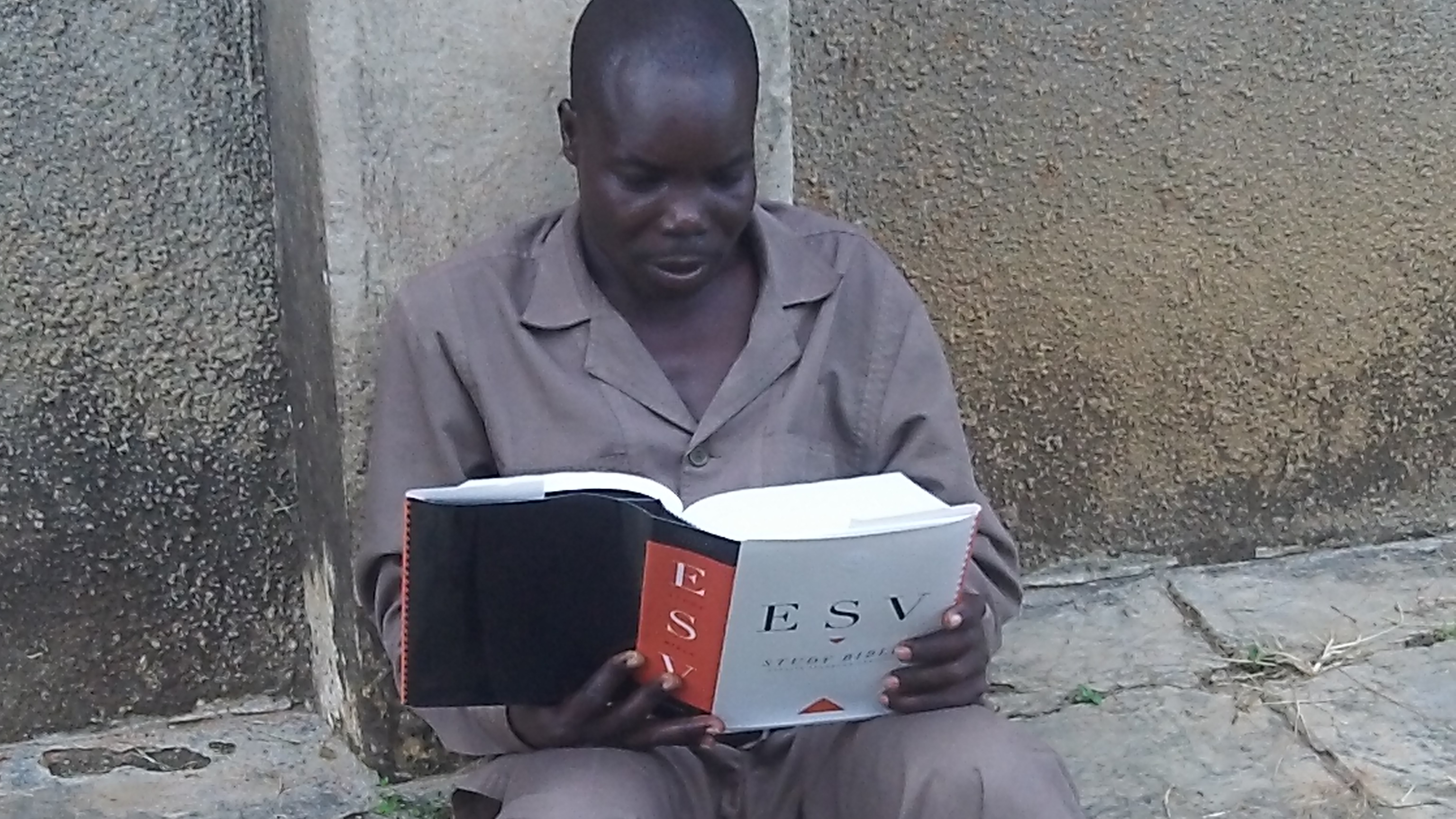
J.I. Packer in North Uganda and South Sudan!

I praise God for the work of the Gospel Coalition International Outreach and  Bill Walsh’s leadership! I have seen first hand the impact of the godly resources they have given to me which I in turn placed into the hands of those thirsting for sound Biblical instruction. May the Lord raise up many to support the Gospel Coalition International Outreach!

———

How You Can Help Relieve Theological Famine Around the World by Bill Walsh

I love this quote from Samuel Zwemer:

The printed [and digital] page is a missionary that can go anywhere and do so at minimum cost. It enters closed lands and reaches all strata of society. It does not grow weary. It needs no furlough. It lives longer than any missionary. It never gets ill. It penetrates through the mind to the heart and conscience. It has and is producing results everywhere. It has often lain dormant yet retained its life and bloomed years later.

I praise God for the way he ordains the use of the written word to call and equip us as his children. The importance of text in the history of the church is difficult to overstate. Whether it’s the Scriptures, the pamphlets of the Reformation, or sermons read by thousands on the internet, God has deployed text as a vital means through the ages. By his design, books continue to be one of the most effective tools for spreading the gospel. And of course, in our day resource formats have exploded to include audio, video, and digital.

And yet, while we in the West often walk out of conferences with huge stacks of free and inexpensive books, much of the rest of the world suffers from a theological famine. In many regions, particularly in the Global South, the cultural, language, economic, and infrastructure barriers mount up. This leaves much of the church vulnerable to false teaching and weakness. God is calling us to address this need.

I’m grateful to Desiring God, where I worked for 13 years, for the incredible platform our team had to launch and grow this effort beginning in 2006. God has overwhelmed us with so many great partners and implemented projects. Now, I’m excited and humbled to join The Gospel Coalition, as we seek, by God’s grace, to expand this mission and its fruitfulness.

The scope of the need is larger than any single ministry can fill. We are looking for publishers, translators, givers, churches, mission senders, and goers who sense a call to engage in Theological Famine Relief. You can help us to create and deploy these resources where they are most needed around the world.

Here’s a quick tour of what you’ll find on our site:

  • Learn about Theological Famine Relief and how you can join us.
  • Explore tools for stirring your heart for the global cause.
  • Browse TGC’s resources in many languages.
  • Consider supporting this effort and our current Relief Projects.
  • Explore our Packing Hope resources for your next missions trip.
  • Pray with us that God will make provision for this ministry to move forward according to his will.
  • Follow our Twitter missions channel on @TGC_IO.

Declare his glory among the nations, his marvelous works among all the peoples! (Psalm 96:3)

Bill Walsh is director of international outreach for The Gospel Coalition. He worked for Desiring God Ministries for 13 years. Starting in 2006, he and a small team built a global network of partners for the cause of Theological Famine Relief for the Global Church. This initiative joined TGC in 2012. He lives with his wife, Cindi, in Minneapolis and has two adult children, Beau and Regan. Contact Bill at Bill.Walsh@TheGospelCoalition.org.

——

Books as Powerful Tools for Theological Famine Relief

If truth be not diffused, error will be.

By Bill Walsh

At a recent conference for Pastors here in the States I witnessed one of the largest conference bookstores that I’ve ever seen. My friends and I commented on the embarrassment of riches that we enjoy in the West. If I desire a certain title, I can have a print copy sent to me in a matter of days. Or I can order the digital version for my iPad in minutes, if not seconds. So much of my Christian growth over the years has depended on books. God has used certain ones to speak to me in specific seasons of my life—with huge results.


The importance of the written word is difficult to comprehend. In terms of church history, its impact would be hard to overstate. God has used the canon of the Holy Scriptures, the writings of the early church fathers, and the pamphlets of the Reformation as vital means of building His church. By His design, the written word continues to be one of the most effective vehicles for passing truth to the next generation.


For hundreds of years, Christians in the West have been privileged to have abundant access to good literature. This wealth of reading goes back to the Gutenberg press, which changed the entire known world in a year. In modern times, access to the written word has greatly increased with the advent of computers and Internet.


Although access to the Internet is increasing, the Global South has generally not yet tasted this bounty. The church there often suffers from a famine of Biblical resources. Many people groups have no Scriptures in their language. Others have no Christian literature to equip pastors and elders to lead their congregations. And where books are lacking, believers are subject to false teaching, undermined doctrine, and weak living.


This disparity of resources gets to the core mission of TGC International Outreach.


When thinking of missions, we typically envision the classic missionary, crossing cultures for the sake of the Gospel. That is still a vital part of God’s plan, especially as we consider the more recent missiological emphasis on ‘from everywhere, to everywhere.’ But many are not aware of the powerful role that literature plays in spreading Gospel truth to the nations.


Here are a few noteworthy quotes that speak to the significance of the written word for the life of believers and for the cause of missions. These are the reasons why text in printed and digital form is at the core of our work in Theological Famine Relief for the Global Church.


The Essentiality of Books

Paul is inspired, yet he wants books; he has been preaching nearly thirty years, yet he wants books; he has a wider experience than most people, yet he wants books; he has been caught up into heaven and heard things which it is unlawful to utter, yet he wants books; he has written the major part of the New Testament, yet he wants books.  – C.H. Spurgeon on 2 Timothy 4:13


The Continuity of Books

There are two things in the entire history of missions that have been absolutely central. One, obviously, is the Bible itself. The other is the printed page. There is absolutely nothing else in terms of mission methodology that outranks the importance of the printed page. Meetings come and go and personalities appear and are gone. But, the printed page continues to speak.  –Ralph Winter

The Versatility of Books

. . . printed books are more portable than pulpits, more numerous than priests, and the messages they contain are more easily internalized.  –Elizabeth L. Eisenstein (The Printing Revolution in Early Modern Europe, p. 169)


The Penetration of Books

The printed page is a missionary that can go anywhere and do so at minimum cost. It enters closed lands and reaches all strata of society. It does not grow weary. It needs no furlough. It lives longer than any missionary. It never gets ill. It penetrates through the mind to the heart and conscience. It has and is producing results everywhere. It has often lain dormant yet retained its life and bloomed years later.  – Samuel Zwemer


The Transcendence of Books

Those of us who have been true readers all our life seldom fully realize the enormous extension of our being, which we owe to authors…In reading great literature I become a thousand men and yet remain myself. Like the night sky in the Greek poem, I see with myriad eyes, but it is still I who see. Here, as in worship, in love, in moral action, and in knowing, I transcend myself; and am never more myself than when I do.  –C.S. Lewis


The Sanctifying Power of Books

You will be in the company of the greatest minds and hearts for the rest of your life, and you will become their peers if you read for understanding and for life.  –John Piper


The Influence of Books

If religious books are not widely circulated among the masses in this country, I do not know what is going to become of us as a nation. If truth be not diffused, error will be; if God and His Word are not known and received, the devil and his works will gain the ascendancy; if the evangelical volume does not reach every hamlet, the pages of a corrupt and licentious literature will.  – Daniel Webster

We are asking God for individuals and churches who will help us build the long-term sustainability of this mission by supporting our International Outreach Capacity Fund. Would you prayerfully consider a monthly gift to this fund, so that we can continue to provide Theological Famine Relief for the Global Church? 

(I’m grateful to William Mackenzie at Christian Focus for sharing several of these quotes with me and for being an inspirational force for book ministry around the world.)


Bill Walsh is Director of International Outreach for The Gospel Coalition. He worked for Desiring God Ministries for 13 years. Starting in 2006, he and a small team built a global network of partners for the cause of Theological Famine Relief for the Global Church. This initiative joined TGC in 2012. He lives with his wife, Cindi, in Minneapolis and has two adult children, Beau and Regan. Contact Bill at Bill.Walsh@TheGospelCoalition.org.