We brought nothing into the world, and we cannot take anything out of the world!

“…we brought nothing into the world, and we cannot take anything out of the world.” (1 Timothy 6:7-See also Ecc. 5:15, Ps.40:17 & Job 1:21). Sobering thought!!! Our lives are like a “vapor/puff of smoke“. Naked and penniless we come into the world and we are buried in the same manner. We are to “number our days” and “redeem” the time for days are few before our death.

The flip side is that we are called to “lay up treasures in heaven“. “Do not lay up for yourselves treasures on earth, where moth and rust destroy and where thieves break in and steal, but lay up for yourselves treasures in heaven, where neither moth nor rust destroys and where thieves do not break in and steal.” (Matthew 6:19-20). What are these treasures in “heaven” which cannot be destroyed?—PEOPLE and our acts of SERVICE done in Jesus and for the spread of HIS fame!

Let us be about living for the ETERNAL!

The ministry model of Jesus…“In the ministry of Jesus words and works, gospel preaching and compassionate service went hand in hand. His works expressed his words, and his words explained his works. It should be the same for us. Words are abstract, they need
to be embodied in deeds of love. Works are ambiguous, they
need to be interpreted by the proclamation of the gospel.
Keep words and works together in the service and witness of
the church.” John Stott

Viewpoint: South Sudan has not lived up to the Hype

According to this report inflation in South Sudan was 80% in May and it now has the  highest maternal mortality rate in the world. These are only a few of the issues this  one year old country faces. Reaching Africa’s Unreached will by God’s grace continue to proclaim the gospel and live out God’s mercy to those in need. Let us pray and work together to make Jesus known here and the surrounding regions!

From the BBC News-Africa:

Viewpoint: South Sudan has not lived up to the hype

Celebrations following South Sudan independence referendum

As South Sudan prepares to celebrate the first anniversary of its independence, blogger PaanLuel Wel discusses whether the world’s newest country has lived up to the hopes of a year ago.

There were great celebrations and high expectations when South Sudan finally seceded from the Sudan on 9 July, 2011.

Yet barely a year into South Sudan’s much-hyped independence, the country has failed miserably to live up to expectations.

It has been gripped by both external and internal problems that are threatening to tear it apart in its infancy.

Nevertheless, there is hardly any regret among South Sudanese citizens for the overwhelming 98% vote they gave for South Sudan’s independence from Khartoum.

South Sudan’s independence was greatly welcomed because it not only heralded the end of more than 50 years of bitter conflict between the two Sudans, but also the beginning of political reconciliation among South Sudanese.

It was also expected to offer South Sudanese an opportunity to embark on the path of much-needed economic development and political democratization.

For the many oppressed South Sudanese, it was to be a new era to finally enjoy those economic privileges, democratic rights and civil liberties that they had long been deprived of by Khartoum.

Sadly though, disillusionment, bitterness and uncertainty now reign large and wide across the young country.

“The government reneged on its promise of free university education as crippling austerity measures were introduced to save money”

Two kinds of problems confront the world’s newest independent nation: Unresolved issues between Khartoum and Juba, and internal issues surround corruption, insecurity and the failure of leadership among South Sudan’s ruling party, the SPLM.

The contested issues between Khartoum and Juba – border demarcations, the contested region of Abyei, the disputes over oil and the accusations of harbouring and supporting each other’s rebel groups – have doggedly undermined the socio-economic and political development of South Sudan.

Disputes have led to deadly fighting in the border town of Jau and the disputed oil-rich town of Panthou/Heglig.

The government of South Sudan has done little since independence to diversify the economy and reduce South Sudan’s dependency on oil revenues, currently at 98% of the national budget.

Although South Sudan took with it more than 75% of total oil reserves after separation, it still needs Khartoum’s oil facilities and port in order to export it to international markets, yet the two countries have repeatedly failed to agree on transit fees.

South Sudan is now calling for international arbitrations over contested borders while Khartoum is demanding that the agreement must be based on the 2005 peace accord borderline, as opposed to the 1956 borders.

The stalemate over the negotiations, coupled with accusations of oil theft and arbitrary oil diversion by Khartoum, prompted South Sudan to shut down all oil productions, sending the economy into free-fall.

Inflation soared to more than 80% in May.

The government reneged on its promise of free university education as crippling austerity measures were introduced to save money.

Sudan People's Liberation Army soldiers
“With all the security problems, military spending remains high”

Making matters worse, South Sudan failed to get any short-term loans from international partners to shore up its dwindling national reserves.

China, the main buyer of South Sudan’s oil, has refused to fund the much-publicised alternative oil pipeline for South Sudan through Kenya.

While the government may not be entirely blamed for all the external problems bedevilling the country, it bears the blame for its internal woes.

Since independence, the SPLM has failed to restore law and order within the country.

Armed rebellions and inter-ethnic violence – fuelled by alleged political marginalization, vote rigging, cattle rustling and land disputes – is widespread across the new nation.

In December 2011, the fighting between the Nuer and the Murle tribes of Jonglei State reportedly killed more than 600 people.

Of the 10 states that make up South Sudan, seven of them are directly involved in either armed rebellions or inter-tribal disputes.

‘Global problem child’

Moreover, South Sudan has not lived up to its expectations because of rampant corruption and wanton mismanagement within the government.

In the wake of the loss of oil revenue, the president was compelled to acknowledge that more than $4bn (£2.5bn) has been lost within the past seven years.

The Africa Debate

Tune in to the BBC World Service at 1900 GMT on Friday to listen to The Africa Debate broadcast from Juba – South Sudan: Has independence lived up to your expectations?

Or take part in Twitter – using #bbcafricadebate – Facebook or Google+

For example, about $200m (£128m) was lost in botched grain contracts and a ministry charged with purchasing government vehicles ended up paying an inflated price of $400,000 (£256,000) per vehicle.

There is a strong perception that top government positions and job promotions are determined by whom you know, not what you know.

The failure by the government of South Sudan to stem the cycles of violence and to eradicate corruption and tribalism has effectively stalled economic development and disrupts social lives.

There is hardly any substantial investment in agricultural productivity, social facilities, infrastructure, trade or development.

This failure has left more than half of the country’s population at the mercy of abject poverty, chronic diseases and violent crimes.

The United Nations Population Fund reports that South Sudan has the highest maternal mortality rate in the world.

This is mainly due to the inadequacy of health care and educational facilities in the new nation.

Nonetheless, it is possible for South Sudan to overcome its major problems.

The government should diversify the economy to reduce over-reliance on oil revenues, while striving to curb corruption and combat tribalism.

Tackling corruption and tribalism would enable the government to invest in sorely needed economic infrastructure and social amenities.

Although people’s expectations were not met and despite the fact that South Sudan is being regarded as “a global problem child” in its infancy, the people of the republic of South Sudan are not regretting their overwhelming vote for independence.

South Sudanese citizens are grateful that they now have an independent state of their own.

PaanLuel Wël is the managing editor of PaanLuel Wël: South Sudanese Bloggers

Sudan: A country divided

Map showing infant Mortality in Sudan, source: Sudan household health survey 2006 The health inequalities in Sudan are illustrated by infant mortality rates. In South Sudan, one in 10 children die before their first birthday. Whereas in the more developed northern states, such as Gezira and White Nile, half of those children would be expected to survive

“The harvest is plentiful, but the laborers are few…”

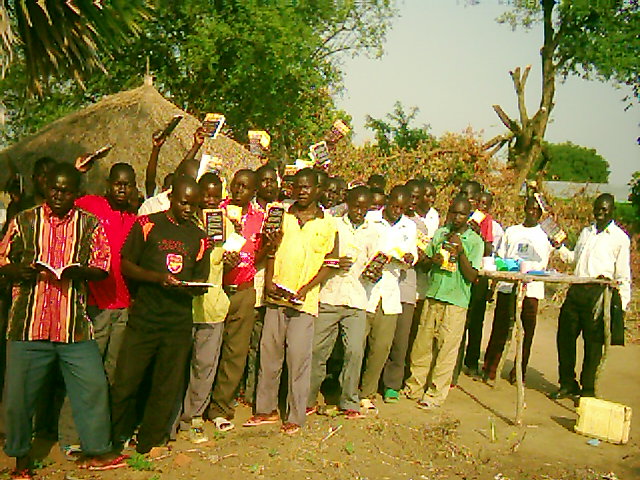
Students in a North Ugandan Secondary School listening to a gospel proclamation.

“Then He (Jesus) said to his disciples, “The harvest is plentiful, but the laborers are few; therefore pray earnestly to the Lord of the harvest to send out laborers into his harvest.”
(Matthew 9:37-38 ESV)

My friend David Sitton has written an excellent exhortation for us based on Luke 10:2-3/Matthew 9:37-38. May all our hearts be stirred in seeking to be part of our Lord’s mission! Thank you David for this word of encouragement!

Forcibly Flung to the Nations – Ekballo

 By David Sitton

The gospel task, essentially, is to take territory for the Kingdom of God.  However, we’re not after geographical conquest.  Rather, we target spiritual strongholds where Satan has exerted his control for centuries.  We are compelled to go after the hearts and souls of people for whom Christ died.

To advance the gospel means that we are to go everywhere extending the Name and the Reign of Christ throughout all of the earth.  That’s the Mission.  God makes his own name great among all of the ethnicities of the earth1 and he does so through the geographical scattering of his people.2

The harvest of nations is an enormous task requiring thousands more of well mentored missionaries than are presently available.  What should be our response to this labor force deficit?

The harvest is plentiful, but the workers are few.  Ask the Lord of the harvest, therefore, to send out workers into his harvest field.  Go!  I am sending you out like lambs among wolves.3

There is a Lord of the harvest.  I’m so grateful that the work of the gospel around the world is in the hands of One who is big enough, wise enough, and powerful enough to manage it.  The harvest of nations is the Lord’s work and he will do exactly what he wants to with it.

As Lord of the harvest Jesus will have a full crop of all the elect from all of the people groups of the world.4 Likewise, he will have a full contingency of harvesters who are necessary to gather them.  All of the goers, all of the martyrs, all of the intercessors and financial senders who are necessary – Jesus will have a full number of everyone and everything that he intends to use for the ingathering of a People for his name and glory.  Jesus is the Lord of the harvest.

There are workers in the harvest. This speaks to the opportunity we have of working with Christ.  Don’t ever forget the magnitude of this privilege.  We get to be missionaries for Jesus Christ!  It is indescribable grace that Jesus allows us to be partners in mission with him.  We get the joy of being front-line spokesmen for Jesus Christ in the far-flung places where his salvation is unknown!

The workers in the harvest are to do two things.  First, we are instructed to “ask the Lord of the harvest to send out more workers.”  Send out in Greek is ekballo, which means to “thrust out violently”; to “forcibly expel”; to “fling out.”  It is a spiritually violent and authoritative word, used for example, to describe the driving out of demons.5 When Jesus commands demons to leave a person or place, they immediately relocate.  In the same way, as we pray for the Lord of the harvest to send out workers, we are asking Jesus to strategically and forcibly redeploy his people into his worldwide harvest.

Prayer is the biblical way, primarily, that missionaries are inwardly compelled to change locations and go somewhere with the gospel.6 We don’t try to twist anyone’s arm or talk anyone into anything.  We pray that the Lord of the harvest will ekballo a work force to accomplish his own work.  In a refreshing way, instead of trying to argue people into becoming missionaries, we go over their heads.  We ask the Lord to compel those whom he wants to carry his gospel seed bags and drive his harvesting combines.  The same authority that expels demons in Jesus’ name propels missionaries to joyfully “pack their coffins” en route for remote and hostile places where Jesus is not known.  When Jesus says, “go!” demons vacate and missionaries relocate.  We do the praying and Jesus does the flinging!

Secondly, disciples are told to pray for harvesters and… What is the first word of Luke 10:3? – “GO!”  Pray and go.  The sense of the text is that we should pray for laborers to go and then get busy being a part of the answer to our own prayers!  This is what the Church is called to do.   We are to pray and go.  Praying, going and sending glorifies God!

Important Question: If working with Christ in the gospel around the world is such a privilege, why is it necessary, so often, for the Lord to forcibly expel his laborers into the mission?  Why aren’t potential laborers lining up for this incredible opportunity?

The answer is in the next phrase.  Jesus forcefully reiterates the implications of going.  “I am sending you out like lambs among wolves.”7

Jesus sends lambs out among wolves!  Is there any doubt what the outcome of that will be?  Jesus is describing a slaughter.  As we go in his name, Jesus says, we’re going as the main course meal!  That’s what lambs are to wolves.  This is a primary reason people refuse to go.  Even believers are not usually eager to line up for a blood bath!

And so, the Lord ekballoes us.  He forcibly flings us out into the world by his grace.  He does it by transforming our hearts.  He makes himself so valuable to us, that suddenly, we begin to “break the jar and pour out all of the oil upon his feet.”8 Our fears and love for this world disintegrate and morph into a passion for his name and compassion for perishing people.  So much so, that nothing else matters anymore.  Jesus becomes our most treasured “pearl of great price” and we find ourselves doing strange things.  We begin to sell homes and land and property.  We begin to take our families, even our young children, into some of the most dangerous and difficult places in the world.  And we do it with joy, because Jesus and the gospel are worth it!

This is what Jesus did.9 He saw the people and was moved by compassion for them because they were distressed, harassed and helpless like sheep without a shepherd.  Jesus came to earth as the Lamb of God to die.  That was the plan from the beginning.  The slaughter of Christ on the cross wasn’t an afterthought or an accident. The Lamb of God intentionally came to die for his sheep.10 After Jesus rose from the dead, he turned to his disciples and said, “As my Father sends me, so send I you.”11

That’s how people become missionaries and how the world will be won for Christ.  That’s how it works.

We do not need a missionary calling.  If we are believers in Jesus Christ we are called to Christ!  If we are called to Christ we are simultaneously called to his mission.  And when we are called to his mission, we don’t “cut and run” when the going gets tough and treacherous.

I’m asking the Lord to ekballo (forcibly expel) every believer in Christ who reads these words.   Some will be ekballoed to actually go as missionary martyrs.  Some will be ekballoed into financial martyrdom, as believers in the early church did.12 First century disciples were frequently compelled by the Spirit of God and by the joy of Christ in their hearts to give in ridiculous ways.  Some of them actually sold homes; some gave land, and many hundreds of thousands of others shed their blood and guts, in extraordinary ways, in order to see to it that the gospel would go to the ends of the earth.

This is the mission of God.  Missionary martyrs going, financial martyrs sending; and all of us praying and working together, for the gospel and the glory of God to be known and enjoyed by all peoples.

____________________

1 Malachi 1:11

2 Matthew 28:18

3 Luke 10:2-3

4 John 6:39; Revelation 5:9

5 Matthew 10:1

6 Persecution is one way that workers are outwardly compelled to change locations and go with the gospel. Acts 8:1-4

7 Luke 10:3

8 Mark 14:3-4

9 Matthew 9:35-37

10 John 10:15

11 John 20:21

12 Acts 2:45; Acts 4:32-36

“The Need to Distinguish Between Domestic Ministry and Frontier Missions”

Below is Dalton Thomas’s excellent piece Driving Convictions Concerning Frontier Missions P4 “The Need to Distinguish Between Domestic Ministry and Frontier Missions” .  I greatly appreciate how Dalton brings clarity to this missions topic. The whole series deserves reading and thinking upon. Thank you Dalton Thomas for this message!


[read the intro]   [read part 1] [read part 2] [read part 3]

At the core of my theology of missions is the distinction between domestic ministry and frontier missions. The New Testament emphasizes this distinction. Therefore, so should we.

I dare say that, to a large degree, the fate of the unreached may hang in the balance.

THE CRISIS OF ACCESS

It’s common in some Church circles to hear statements like these:

“We’re all called to be missionaries.”

“America is as much of a missions field as India.”

“Missions is as much about going across the street as it is about going overseas.”

“You don’t need to go to the other side of the world to do missions. There are unreached people all around us!”

While such assertions appear noble and sound beneficial to the Church’s evangelistic efforts, they lack biblical substance and have grave consequences for the unreached among the nations.

We are all called to live on mission where ever we are. And we are all called to obey Jesus’ command to make disciples of all nations–even our home nations. I don’t deny these things! But in our desire to stir passion for the lost around us, we need to discern the apostolic perspective concerning the crisis of unreached people groups.

When we use the term “unreached people groups” we’re not talking about lost people in Orlando, Sydney, and Edinburgh. We’re referring to lost people who don’t have access to a Church, a Bible, or a follower of Christ. According to the Joshua Project there are almost 17,000 ethno-linguistic people groups. Just under 7,000 of them don’t have access to a Church, a Bible, or a Christian.

Those 6,000+ people groups who have never had the opportunity to hear the Gospel are the reason why I think it’s so important to distinguish between domestic and frontier ministry. As long as we believe that “missions is missions wherever you are,” we won’t be able to see the crisis for what it is. Consequently, we will live free from the appropriate burden that is ours to bear.

THE DIFFERENCE BETWEEN PAUL AND TIMOTHY

In the New Testament there is a clear distinction between the work of the evangelist in a location where the Gospel has penetrated at some level, and a location where the name of Jesus has never been spoken. A comparison of two passages makes this distinction quite clear. In II Timothy, we read of Paul’s words to a young man who was established in a city (possibly Ephesus) where Paul had previously labored.[1] He wrote to Timothy saying

. . . do the work of an evangelist, fulfill your ministry. (1 Timothy 4:5)

The “work of an evangelist” and the “ministry” to which Timothy was called was in a city in which the Gospel had already been preached and a Church already established. This is what we mean by “domestic ministry.” He was laboring in a location in which the Gospel had already penetrated. He was hard at work among a community in which seeds of Gospel truth were being scattered by an established Church Body. Let’s compare this with Romans 15 where Paul explains his own calling.

I make it my ambition to preach the gospel, not where Christ has already been named, lest I build on someone else’s foundation . . . (Romans 15:20)

Timothy was fulfilling a ministry of domestic evangelism. Paul was fulfilling a ministry of frontier evangelism. Timothy was “building on a foundation” that was laid by “another.” Paul was driven by passion to lay the foundation in regions where there wasn’t one.

EMBRACING THE CALL TO FRONTIER MISSIONS

Frontier missions and domestic evangelism are both legitimate callings that are indispensible to the advance of God’s purposes in the nations. It is important therefore that we do not exalt one above the other. Both are to be honored, proclaimed, and embraced. Some are called to pour themselves out in “Ephesus” where the Gospel has taken root, and some are called to pour themselves out in “Macedonia” where the name of the Lord has yet to roll from the tongue of even one individual. We must be careful to never hold one in a higher regard than the other. However, with that said, it is apparent that the Church needs to hold frontier missions in a higher regard than we currently do.

Tragically, at this point, frontier missions is simply not a priority to most in the western Church. We invest less than 1% of our resources into ministry to unreached people groups. This means that either God is unconcerned about the issue (which leaves Him responsible for the near wholesale avoidance of these people), or it is we who are indifferent (which places the guilt of negligence upon us). The website of one missions organization puts it this way:

If everyone is obeying God’s “calling” to be a missionary wherever they are then God is calling 99.9995% of people to work among the 44.3% of the world population that already has the gospel, and calling virtually no one (.0005%) to relocate among the other 53.7% of the world population that are not Christian. You have a better chance of being in a plane crash than being one of the 2 billion Christians in the world that are UPG [Unreached People Groups] missionaries.[2]

The fact that we in the west are so unconcerned about the unreached and unengaged is an injustice of epic proportions. Still, after two thousand years, half of the earth’s population has never met an ambassador for Christ! In the book The Spiritual Secret of Hudson Taylor, the son and daughter-in-law of the frontier missionary recall the story of an interaction between Taylor and a new and deeply grateful Chinese convert. The new believer confronted him and

unexpectedly raised the question: “How long have you had the Glad Tidings in your country?” “Some hundreds of years,” was the reluctant reply [from Taylor]. “What! hundreds of years? “My father sought the Truth,” he continued sadly, “and died without finding it. Oh, why did you not come sooner?” It was a moment, the pain of which Hudson Taylor could never forget, and which deepened his earnestness in seeking to bring Christ to those who might still be reached.[3]

PUTTING FRONTIER MISSIONS INTO PERSPECTIVE

The Joshua Project[4] has done extensive research concerning the progress of the Gospel in the nations among the unreached and unengaged. Their research puts the task of frontier missions in perspective.[5] As of November 2011 they reported the following statistics about the progress of the Gospel by people group and global population.

Progress by People Group

Total People Groups: 16,750
Unreached People Groups 6,921
% People Groups Unreached: 41.3 %

Progress by Population

World Population: 6.83 Billion
Population in Unreached People Groups: 2.84 Billion
% of Population in Unreached People Groups: 41.5%

The largest religious block on the map of the unreached and unengaged is Islam. The Joshua Project reports these sobering statistics.

– The population of the Muslim world is 1,537,185,000.
– Within that population of 1.5+ billion people are 2,840 different unreached people groups.
– 87.4 % of those 1.5+ billion people have yet to hear the Gospel.
– Or, to say it another way, 1,343,613,000 Muslims have yet to hear the name of Jesus.

THE FINAL FRONTIER OF GLOBAL MISSIONS: ISLAM

While every religious block constitutes a substantial challenge to the global Church, clearly Islam is the most daunting. It is the largest as well as the most hostile. Consequently, the number of missionaries on the field is tragically few. In the wake of the September 11th attacks, Joshua Lingel explained the level of activity within this block by saying that

Only one percent of all Christian missionaries go to do direct ministry amongst Muslims (1,800 missionaries total). That’s one missionary for every 550,000 Muslims! For every Mormon you have ever met, there are 130 Muslims in the world. That’s equivalent to having about five churches and 150 pastors for all of North America. Said differently, it would be like having the option to go to church in Texas (if you’re fortunate to be that close) or say Boston perhaps, and three other locations in the U.S. on any given Sunday morning.[6]

This should take our breath away, especially considering that the challenge of engaging the Islamic world is not new. Writing from Bahrain in 1902, Samuel Zwemer, the American missionary, historian, and “apostle to Islam,” appealed to an emerging generation of Christians saying that

the twentieth century is to be preeminently a century of missions to Moslems.[7]

The twentieth century has come and gone. And the majority of the Islamic world remains unreached and unengaged. While the number of laborers has considerably increased since Zwemer’s day, so also has the population of Muslims. In other words, we are no closer now than we were 100 years ago to accomplishing the task of establishing a faithful Gospel witness among those whose allegiance now belongs to Mohamed. The proverbial boundaries of the field have expanded, and the Church in the west has not proportionally expanded its efforts to reap it. Thus, it is a harvest which remains ready, yet largeley unengaged.

The challenge of serving the Muslim world demands a thoughtful and sober response. This will be the final frontier of world missions and the Church’s greatest challenge. It will by no means be the only challenge. But it will be the greatest, and the costliest.

The Church is long overdue in its response to embrace the responsibility of engaging the Islamic world. The dangers that will accompany our doing so are real. But so are the scriptural commands to preach the Gospel to all peoples, and the promises of a harvest from every tribe and tongue. The moment we exalt the dangers above the commands and the promises that accompany them, we have gone astray. Thus, while it would be foolish to ignore the dangers, we must be careful to view them in light of all that Jesus has commanded and promised us.

CONCLUSION
The fact that over 40% of the earth’s population is considered unreached after 2,000 years is not OK.
We don’t avoid the unreached peoples of the earth because of a lack of resources. As Leonard Ravenill said, ”Today Christians spend more money on dog food then missions.” The issue is motivation. We don’t believe that the task is worth the effort and the blood. Acknowledging the difference between domestic and frontier ministry isn’t the solution. But it’s a step in the right direction.
Without a biblical understanding of the differences between domestic and frontier ministry we will be unable to discern our role in the great drama at the end of the age. The Gospel of the Kingdom will penetrate every nation, people, language, and tribe (Mt. 24:9, 14; Rev. 7:9-14). And we have a part to play. But without this crucial framework, we will be blind to the crisis at hand, the urgency of the hour, and the monumental importance of the task.
“And this gospel of the kingdom will be proclaimed throughout the whole world as a testimony to all nations, and then the end will come.” (Matthew 24:14)


[1] Visit joshuaproject.net for more information.

[2] Statistics of this kind vary depending on who is compiling the information and how. The Joshua Project is the most reliable by virtue of their extensive research.

[3] Joshua Lingel, “Consider Again Your Vocation,” i2 Ministries (website), accessed November 2011, http://www.i2ministries.org/index.php?option=com_content&view=article&id=13:consider-again-your-vocation&catid=27:articles-category&Itemid=72.

[4] Samuel M. Zwemer, Raymund Lull: First Missionary to the Moslems (Diggory Press, 2008) Kindle Edition, Preface.

[5] See Acts 19

[6] The Traveling Team (website), accessed October 2011, http://www.thetravelingteam.org/node/186/generalstatistics.

[7] Dr. and Mrs. Howard Taylor, Hudson Taylor’s Spiritual Secret, (Chicago, IL: Moody Publishers, 1955), 81.