December News and Updates

Dear Friends and Family,

Merry Christmas from Carol and me and from my Reaching Africa’s Unreached co-workers Patrick, Abraham, and Sam. May your Christmas be filled with the joy of Immanuel (God with us)!

For followers of Christ, Christmas is the celebration of something that historically took place, is miraculous—God humbling Himself to become man, and opens the way for the salvation of sinners like you and me. It is the day when we remember the birth of our Savior—our Savior, the eternal second member of the Trinity; at the same time He became a man who lived on this earth in complete obedience to the Father, died for sinners on the cross, was raised from the dead, and now sits at the right hand of God the Father! Note Jesus words in John 1:1-3 &14: “In the beginning was the Word, and the Word was with God, and the Word was God. He was in the beginning with God. All things came into being through Him, and apart from Him nothing came into being that has come into being. . . . And the Word became flesh, and dwelt among us (literally “tabernacled among us”), and we saw His glory, glory as of the only begotten from the Father, full of grace and truth.” Christmas is time for remembering these truths and rejoicing in our Savior!

God’s blessings have been with us! As many of you know, in 2010 several Ugandan pastors and I established Reaching Africa’s Unreached (R.A.U.)!  R.A.U.’s expressed goal is to strengthen local churches and pastors through Biblical exposition in the fundamentals of the Christian faith so that they are better equipped to shepherd their flocks and plant churches in the many unreached villages of North Uganda, South Sudan, and Northeast Democratic Republic of Congo. On many occasions I have heard pleas from pastors for sound biblical instruction and quality Christian literature. We have had opportunity to hosts dozens of conferences, distribute several thousand good Christian books and distribute five hundred Study Bibles to church leaders. Discipleship is paramount in the “Great Commission” (Matthew 28:18-20). We hope to do much more of this by God’s grace!

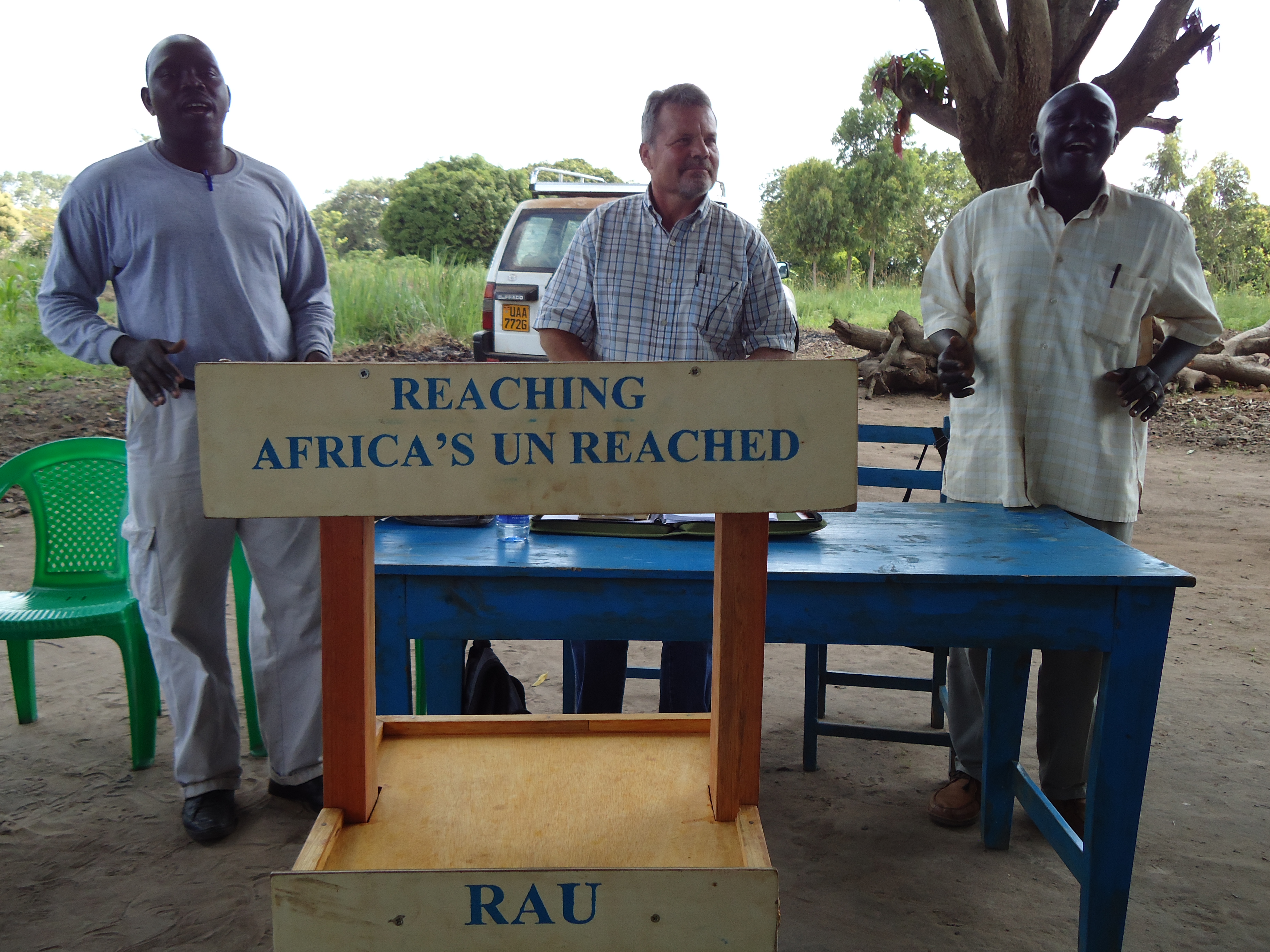
One of R.A.U.'s many pastor's conferences.
There is a great hunger for good solid Christian literature!
2 Timothy 2:2
2 Timothy 2:2

R.A.U. will also continue to seek to show the love of Jesus through various mercy ministries. There have been some very serious conflicts in all three of these countries for many decades. The Bible calls us to be “zealous for good works” (Titus 2:11-14)! The needs remain great and the Lord has positioned us strategically here to be His hands and feet. As my friend Kevin Turner, President of SWI, has aptly said, “We are called to bring a two fisted gospel (to passionately preach the gospel and actively participate in mercy ministries)!”  The most important thing we can do during our lifetimes is to ardently and faithfully proclaim the gospel of Jesus Christ in word and deed!

There are many opportunities to show the love of Jesus!

I have had the privilege of making numerous relationship building trips to this region since 2006. They have been an extreme blessing in so many ways! Through these trips a rapport as been built with many Christian brethren, pastors, tribal leaders, and local/regional government leaders. The Lord has used these connections to open many doors of ministry for R.A.U.

In January of this year the Lord providentially granted us the opportunity to purchase 12 acres one mile south of the border of South Sudan and five miles north of Moyo North Uganda. South Sudan became the world’s newest country this last July. At our web site you can find the story of how the Lord connected the many “dots” to make this purchase possible. The Lord is to be praised! This land’s strategic location will enhance R.A.U.’s ability to bring in pastors, church leaders, church planters, and evangelists for retreats/conferences and for Biblical encouragement (See 2 Timothy 2:2). The R.A.U. compound will also serve as a base of operations to launch such conferences throughout North Uganda, South Sudan, Northeast Democratic Republic of Congo, and Lord willing further North.  Furthermore, the twelve acres gives opportunity to have a Medical/Dental Clinic, Orphan Care Center, Christian Day School for children, and a Vocational Training Center for adults with Micro-Finance opportunities. It now also looks as if we will have an opportunity to purchase 3-4 adjoining acres. Our plan is to plant numerous fruit bearing trees (mainly Mango and Orange trees) on the 12-16 acres which would bring in a future income to help supplement our ministry efforts.

This past summer we began earnest work on the land. The Lord has granted us the means, through the faithful gifts and hard work of His people, to pour a slab for the Guesthouse, build a perimeter fence, and to construct a number of homes on some nearby land for refugee families which had been living on our newly purchased land. We have also have been able to build a traditional African home (tukalo) near the future Guesthouse for co-worker Sam Nyombi. Sam is a Registered Nurse and will live there to help watch over the property and aid in ministry outreaches. Pictures and details of this building work can be found on the “Picture” page on the website.

Working on the RAU Guesthouse slab
Completed Guesthouse slab

It is Carol’s and my hope that we will be able to move into the Guesthouse sometime in 2012. For this move to take place, the Guesthouse will need to be completed. This is where we will make our new home and begin to learn the local language, Madi, and to serve and participate in the local church. The Guesthouse will also allow us to host ministry teams and will be the headquarters of R.A.U.   Carol and I know the Lord has been preparing us in numerous ways all of our lives for this calling. Please be in prayer for us as we work towards this move. The hardest part for us is leaving our many friends and dear family. With the birth of our first granddaughter this year this has been made even clearer to us. Thank you for your prayers, much grace is needed!

Our beautiful granddaughter !

With the inflation rate over 70% in South Sudan, over 30% in Uganda and a bad economy in the USA building has been challenging on this pristine piece of bush land. Nevertheless, the Lord has graciously provided for each step we have taken and I know He will continue to do so. To those of you who have sacrificially given –Thank you!

Below is a list of the most immediate needs/goals for your prayers. Please also pray about partnering financially with us. We commit to use each dollar faithfully for the Lord’s glory! When moved, Carol and I would love to host you in a short term ministry outreach!

  1. Completion of Guesthouse: $30,000.00 +-
  2. Drill a well/water storage tanks: $7-10,000.00
  3. Durable used 4 wheel drive vehicle. This vehicle is a necessity for the type of ministry in which we will be involved.  We have been told the best vehicle to get is a Toyota Land Cruiser with a snorkel breather (for crossing streams) and a winch. We will be selling our car and truck here ($15,000+-) to help pay for this vehicle. A used Toyota Land Cruiser runs from $30-40,000 …ouch!
  4. Fruit Trees (They begin to bear fruit in about six years): $5,000.00+
  5. Moving Costs: unknown at this time

All gifts are tax deductible. Information on how to give securely through PayPal can be found at our website. Checks may be written to “Lifegate Ministries-R.A.U.” and mailed to:

Jacob Lee-RAU

3063 North Highway 123 Bypass Apt. 415

Seguin, Texas 78155

Blessings,

Jacob Lee

Let us work together to spread the FAME of King Jesus throughout South Sudan, Northeastern Democratic Republic of Congo, and North Uganda!!

South Sudan Nhial Deng Nhial: We are on brink of war

Please keep South Sudan and Sudan in your prayers along  with the Democratic Republic of Congo!!

A blessed time of testimony and teaching with men from Darfur who have been called back to their home land to plant churches.
A blessed time of testimony and teaching in South Sudan with men from Darfur who have been called back to their home land to plant churches.

———-

From BBC News Africa: South Sudan Nhial Deng Nhial: We are on brink of war

South Sudan’s foreign minister has warned his country is on the brink of war with Sudan following days of fierce fighting along the border.

Nhial Deng Nhial told the BBC Sudanese forces had invaded the town of Jau, which was in the south.

He urged the international community to intervene and said he hoped full-scale hostilities could still be avoided.

South Sudan seceded from the north in July following years of civil war in which some 1.5m people died.

The border between the north and south has not yet been officially designated.

Since July Khartoum and Juba have accused each other of supporting rebels in the border areas.

‘Tanks and aircraft’

Mr Deng Nhial said the clashes in Jau, which he said was a town in Unity state, were the biggest threat to peace since South Sudan’s independence.

“Although there have been frequent aerial bombardments of different places in the Republic of South Sudan, we think that Khartoum has raised this offensive to an entirely new level by committing ground forces to cross into the Republic of South Sudan,” he told the BBC’s Focus on Africa programme.

“We are still very much committed to the principle of dialogue with Khartoum – we are still hopeful that we can pull back from the brink of outright war.”

Earlier, Col Philip Aguer, spokesman for South Sudan’s army – the South People’s Liberation Army (SPLA) – told the BBC that Khartoum had used tanks and long-range artillery in the offensive on Jau, which started on Saturday.

Outstanding secession issues

• Blue Nile and South Kordofan have not had popular consultations about their future, due before the split

• Abyei has not held a referendum on whether to join north or south, due before the split

• Sharing oil revenues

• Exact border demarcation

Antonov aircraft had also bombed the area, he said.

Southern troops had now recaptured the town, but Sudanese soldiers were still in South Sudan, he said.

“This is a war situation and if they don’t withdraw, the SPLA will force them out,” Col Aguer told the AFP news agency.

Across the border in the state of South Kordofan, Sudan’s army has for several months been battling rebels, who once fought against Khartoum during the civil war.

South Kordofan is one of several border areas which failed to hold popular consultations about their future ahead of South Sudan’s independence.

Mr Deng Nhial denied accusations that his government was supporting the rebels in the northern border areas, known as the SPLM-North.

“We had been associated with the SPLM-North during the years of our struggle. After independence we severed all military ties with our units in the north and we didn’t provide any additional equipment,” he said.

The foreign minister said it was important that the border be properly demarcated.

“Khartoum continues to drag its feet although we are agreed that close to 80% of the border is no longer in dispute,” he said.

“This in our mind raises serious suspicions.”

Map showing disputed border area of Abyei

More on This Story

Sudan: Coping with divorce

Birth of a nation

More Africa stories

  • Supporters of Democratic Republic of Congo's opposition leader Etienne Tshisekedi burn a tyre as they demonstrate in Kinshasa on 9 December 2011 Four dead in DR Congo poll unrest

    Four people have died in violence in DR Congo following poll results rejected by the main opposition candidate, the country’s police chief says.

Appeals for calm after disputed Democratic Republic of Congo Election…

Please pray for the Democratic Republic of Congo! We have  the privileged of working there !

Pastor's Conference in Democratic Republic of Congo


——————————

From BBC Africa: Appeals for calm after disputed DR Congo Election:

Unrest in Kinshasa. 9 Dec 2011 Burning tyres sent palls of smoke over areas in Kinshasa loyal to Etienne Tshisekedi

There have been appeals for calm in the Democratic Republic of Congo following the victory of President Joseph Kabila in disputed elections.

Main opposition candidate Etienne Tshisekedi has rejected official results and declared himself the winner, raising fears of violence.

Mr Tshisekedi along with the EU, the US, Britain, France and former colonial power Belgium appealed for calm.

Riot police are patrolling the capital, Kinshasa, and gunshots have been heard.

The city, in the west of the country, is an opposition stronghold and columns of smoke were seen rising over districts backing Mr Tshisekedi as groups of young men burned tyres.

On Friday evening, election commission chief Daniel Ngoy Mulunda announced that President Kabila had gained 49% of the vote against 32% for Mr Tshisekedi.

Many shops and stalls in Kinshasa’s markets have been closed for most of the week as the country awaited the results, which were delayed by several days.

Etienne Tshisekedi

We have done our own calculations and I received 54% to Kabila’s 26%. His term is finished. I am the president”

Etienne Tshisekedi Opposition candidate

Meanwhile, in areas loyal to President Kabila, mainly in the east of the country, residents cheered and supporters staged victory parades.

“I reject these results, and in fact I see them as a provocation against our people,” said 78-year-old Mr Tshisekedi.

“It is scandalous and vulgar. We have done our own calculations and I received 54% to Kabila’s 26%. His term is finished. I am the president.”

Mr Tshisekedi later appealed to his supporters to “stay calm and peaceful”.

However, he added that he was waiting to see if diplomatic efforts would change the situation.

The army says it has about 20,000 soldiers on standby in Kinshasa. The atmosphere in the city is said to be tense.

UN Secretary-General Ban Ki-moon called for “any differences regarding the provisional results of the polls to be resolved peacefully through available legal and mediation mechanisms”.

The French Foreign Ministry appealed for peace, saying: “France calls on all Congolese political players to show restraint and a spirit of responsibility.”

US State Department spokeswoman Victoria Nuland said Washington was calling on DR Congo’s leaders and their supporters “to act responsibly, to renounce violence, to resolve any disagreements they might have through peaceful dialogue”.

Who is Joseph Kabila?

Supporters of President Kabila with banner
  • 40 years old
  • Born in a rebel camp in eastern DR Congo – where he enjoys most of his support
  • Spent his childhood in Tanzania
  • His father, Laurent Kabila, overthrew long-time ruler Mobutu Sese Seko in 1997
  • He first became president after his father’s assassination in 2001
  • Oversaw the signing of a peace accord in 2002 to end a five-year conflict involving several other nations
  • Became DR Congo’s first freely elected leader in 2006, winning a run-off poll with 58% of the vote
  • His campaign slogan was: “Five building sites of the republic”
  • Shies away from public speaking
  • Is married with one daughter

The announcement of the results had been delayed since Tuesday, with election officials blaming logistical problems.

Four other candidates have said the election was rigged and should be annulled.

International observers said the vote was flawed but stopped short of calling it fraudulent. Most said the irregularities were not enough to change the outcome.

Deadly clashes marred the period leading up to the election and thousands of foreigners and Congolese have fled the country for fear of further violence.

Mr Kabila, 40, has been president since 2001 following the death of his father, Laurent.

In 2006 he won the first elections since the end of a five-year conflict and is due to be sworn in on 20 December for his second term.

But his victory must first be confirmed by the supreme court.

He enjoys greater popularity in eastern areas, where his origins lie and where he is credited with helping to end the war.

However, he is less popular in the west, partly because he is not fluent in the local Lingala language and because some see him as representing foreign interests.

Mr Tshisekedi has said he has no intention of taking an election dispute to the court, which he regards as “Kabila’s private institution”.

Earlier this year, the constitution was amended so that the candidate with the most votes would win the election, removing the need for a second round.

The BBC’s Thomas Hubert in Kinshasa says the move succeeded in dividing the opposition.

But it means Mr Kabila is bound to face legitimacy challenges as he has been re-elected with less than 50% of the vote, amid widespread suspicion of electoral fraud and with very little support in the west.

Although DR Congo is rich in minerals such as gold and diamonds, years of conflict and mismanagement mean it recently came bottom of a survey of living standards around the world.

“Failed state: Can DR Congo recover?”

Please keep the Democratic Republic of Congo in your prayers. Especially lift up our Congolese brothers and sisters in Christ. The Christians I have met there are beautiful examples of God’s grace, love, and faithfulness in the midst of much difficulty. Pastors are hungry for biblical teaching and literature. Please pray for Reaching Africa’s Unreached as we seek to come alongside God’s work in this beautiful country….thank you!!!

R.A.U. in Northeastern Democratic Republic of Congo
R.A.U. pastor's conference in Northeastern Democratic Republic of Congo
A R.A.U. pastor’s conference in Northeastern Democratic Republic of Congo
Congolese Pastor receiving John Piper books in French
Northeastern Democratic Republic of Congo

The article below comes BBC Africa:

Failed state: Can DR Congo recover?

A Congolese rebel holding a rocket and lighting a cigarette (Archive shot)

DR Congo: Dreaming of Democracy

As the Democratic Republic of Congo prepares for just its second general elections in four decades on 28 November, Congolese affairs analyst Theodore Trefon considers whether this failed state, still recovering from a war which led to an estimated four million deaths, can ever be rebuilt.

People in the Democratic Republic of Congo expect very little from the state, government or civil servants.

In fact, ordinary Congolese often repeat expressions like “the state is dying but not yet dead” or “the state is ever present but completely useless”.

It seems they also expect little from the upcoming elections and there can be little argument that DR Congo is indeed a failed state.

Ordinary citizens are poor, hungry and under-informed.

The government is unable to provide decent education or health services.

The country – two-thirds of the size of western Europe – is a battleground.

The citizens of DR Congo pray to be delivered from the brutal militias that still control parts of the eastern provinces, where rape has become so commonplace that one senior UN official called the country “the rape capital of the world”.

The Democratic Republic of Congo covers 2,344,858 square km of land in the centre of Africa, making it the 12th largest country in the world.

Predators

I asked a university colleague if he thought things could get worse.

“Well, there was an eclipse that day”

Excuse for missing a meeting

“When you are rock bottom, you can still dig deeper,” was his response.

Public administration is in shambles. Civil servants have mutated into predators.

Ferdinand Munguna is a retired railway worker in Lubumbashi, the mineral capital of DR Congo in the south of the country.

He has to bribe the man working in the pension office who requires “motivation” before processing the old man’s file. Mr Munguna complains that his pension is “hardly enough to buy soap”.

Starting a business in DR Congo takes 65 days compared to the sub-Saharan African average of 40 days. In neighbouring Rwanda it takes three days.

And guess which country has one of the worst air safety records worldwide?

The prestigious Foreign Policy magazine’s Failed States Index puts DR Congo in the critically failed category. Only Somalia, Chad and Sudan (when it included South Sudan) have worse rankings.

The recently released UNDP report on human development indicators put the former Belgian colony at the bottom of the 187 countries it surveyed.

Congolese school children in Kinshasa (Archive shot) DR Congo, Africa’s second largest country, has a literacy rate of 67%

On the political front, President Joseph Kabila has shown much more interest in regime consolidation than implementing his five-point development agenda – which most Congolese consider more as a political slogan than a development initiative.

When criticised, Mr Kabila’s henchmen resort to the ultimate force of dissuasion.

Take Zoe Kabila, the president’s brother, who ordered his Republican Guard escort to beat up two traffic officers because they did not give his 4X4 priority.

Usually immune to the brutality of the security forces, even people in Kinshasa were shocked by this incident at a busy downtown intersection.

Numerous cases of journalist beatings and killings have also been reported.

Floribert Chebeya, a highly respected human rights activist was murdered, allegedly by members of the president’s inner circle.

Unfair Congo bashing

Poor leadership is a major problem for DR Congo.

When there’s no state…

In the absence of a functioning state or similar, even the best-intended projects can have perverse side effects if they are carried out without comprehensive feasibility studies or efforts to understand local culture and practices.

An international medical NGO provided mosquito nets to a poor village in the Upemba region of Katanga. Many lakeside villages in the mineral-rich province suffer from a high rate of malaria-induced child mortality. Sleeping inside these nets is the best way to avoid mosquito bites and malaria. But this laudable action created a human and ecological catastrophe.

As the mosquito nets were free and abundant, fisherman used them as fishing nets. Given their extremely fine mesh, not only were fish removed from the lake but all other forms of micro-fauna and micro-flora too. The lake gradually became covered with a black scum. Villagers lost their sources of livelihood and food supply.

It took a Belgian priest two years to get the villagers, who believed they had been cursed, to realise what had happened and before the lake was able to regenerate.

There are few figures on the political landscape with vision, leaders able to bring an end to corrupt government, reduce poverty, solve the country’s security problems or improve the well-being of ordinary people.

DR Congo bashing has become a mantra amongst academics, humanitarian non-governmental organisations (NGOs) and policy makers.

But I think that this is unfair.

While it is important to maintain pressure on Kinshasa’s unabashedly corrupt political establishment, we also have to consider the country’s troubled past.

Few societies have accumulated so many woes.

Those old enough to remember say the whip and chain is what they associate most with Belgian colonialism.

Others however are nostalgic and wish for the Belgians to return to solve the country’s problems.

Cold War policies facilitated the maintenance of the brutal dictatorship of Mobutu Sese Seko.

He ruled what was then named Zaire for 32 years, supported by the West because of Cold War strategic interests.

Two wars – the liberation war that toppled Mobutu and “Africa’s first world war”, from 1997-2002 – are overwhelming obstacles to development, state-building and well-being.

DR Congo is also victim to what is commonly referred to as “the resource curse”. The central government cannot control borders with its nine neighbours.

Much of DR Congo’s coltan, a mineral used in computers and mobiles, is illegally exported through Rwanda. Precious tropical hardwoods are siphoned off through Uganda.

Surreal

DR Congo’s financial and technical partners – the so called “international community” – are also to blame.

A rickety bridge in DR Congo (Copyright Theodore Trefon) DR Congo’s road to development is paved with good intentions

They have no master plan for reform. They do not share a common vision and often implement contradictory programmes.

Belgium supported the idea of decentralisation arguing that it could bring government accountability down to the grassroots level. The World Bank blocked the process.

Bank experts have some control of the treasury in Kinshasa but they have absolutely no idea of how resources in the provinces are managed.

Data collection is a surreal concept in DR Congo – many offices do not have electricity, let alone computers.

Absence of national sovereignty is another hallmark of a failed state.

DR Congo is a country under international trusteeship. Important decisions are taken by World Bank technocrats, UN officials and increasingly by international NGOs.

When the electoral campaign officially opened last month, candidates travelled to Europe and the US to garner support.

The UN mission, Monusco, is playing a key logistical role in the elections by transporting ballot boxes across the vast nation. People would not be able to vote without this kind of support.

Whatever accountability there is in DR Congo is directed towards international backers, not the Congolese people.

Congolese authorities have abdicated from the development agenda.

Road rehabilitation and bridge building have been delegated to the World Bank and Belgian Technical Cooperation.

Monusco is supposed to look after the security sector. The World Health Organization and medical NGOs try to deal with the public health challenges.

The UK is involved in reinforcing governance programmes, while churches provide primary education.

The state is an absentee landlord – outside partners do its work.

Dynamic survivors

So DR Congo is on an artificial life-support system. But replacing the state, or acting on its behalf, is not viable in the long-term. It undermines state-building momentum.

DR Congo in figures

  • Population: 70 million
  • UN human development index: Bottom of 187 countries surveyed
  • Life expectancy: 48 years
  • Has 70% of the globe’s coltan – vital for mobile phones
  • Average annual income: $300
  • With 13% of the world’s hydropower potential, its network of rivers could power much of Africa
  • Just 9% of the population has access to electricity

Sources: Estimated figures from the UN and World Bank

DR Congo and its partners are clearly confronted by the tragedy of powerlessness.

The system is such that when things do not work, go wrong or do not move forward, it is never really anyone’s fault.

There are plenty of good excuses. A colleague told me when asked why he did not show up for an appointment: “Well, there was an eclipse that day.”

While DR Congo is clearly a failed state, Congolese society has not failed.

On the contrary it is strong, vibrant, dynamic, tolerant and generous. People have a sense of taking charge of their own destinies.

Women form rotating credit systems to compensate for the absence of an accessible banking system.

Farmers band together to hire a lorry to get their cassava or charcoal from the central city of Kikwit to market in Kinshasa.

Bebe, who lives in the Paris suburb of Griney, sends money home to Kasai via Western Union. Some months it contributes to school fees, others it pays for medicines for her ailing mother-in-law.

Her father will spend some of it on Primus, the beer of choice in Kinshasa.

“Elikia” means hope in Lingala and there is much of it throughout the country.

Hopes for positive change will come from the people, not from the Congolese political establishment, and certainly not from outside interventions.

Theodore Trefon is senior researcher at the Royal Museum for Central Africa and author of the blog Congo Masquerade: The political culture of aid inefficiency and reform failure.

On 25 November, the BBC World Service is broadcasting a special one-hour debate in front of a Kinshasa audience: Is DR Congo a failed state? Tune in at 1900 GMT.

More on This Story

DR Congo: Dreaming of Democracy

Election countdown

Background

South Sudan October inflation jumps to 71.7 percent

The R.A.U. Guesthouse foundation is complete. Please pray for its completion!
The R.A.U. Guesthouse foundation is finished. Please pray for the completion of the Guesthouse.
With the inflation rate of 71.7% in South Sudan and 30%+ in Uganda it makes life very difficult in these two countries…please pray!
Please also pray for R.A.U. that we will be wise with what we have and that the Lord will continue to touch hearts to partner financially with us. At this time we have about 5% of the needed funds to complete the R.A.U. Guesthouse. The Guesthouse will be Carols and my home as well as the hub for R.A.U.’s ministry.
“South Sudan’s annual inflation rate jumped to 71.7 percent in October from 61.5 percent in September on a new surge in food prices, the new African nation which is struggling to provide adequate food supplies said.
South Sudan became independent on July 9 under a 2005 peace agreement with its former civil war foe, Khartoum, but has been struggling to fight an economic crisis and contain tribal and rebel violence that has killed thousands this year.
The United Nations has warned the new underdeveloped nation will be facing severe food shortages from next year because it will produce less than half what is needed in 2011 due to heavy rain and widespread violence.
Month-on-month inflation accelerated 7.4 percent in October as food and non-alcoholic beverage costs — the biggest component in the consumer price index — rose by 11 percent.
Costs for bread, cereals, meat, fish, grain and other basic food items rose, the National Bureau of Statistics said on its website. On an annual level, the costs for food and non-alcoholic beverages rose by 78.5 percent in October.
Landlocked South Sudan has been hit hard by a temporary closure of the joint border with north Sudan from which its buys much of its food and other needs.
Both countries reached a border agreement to facilitate travel last month, but a lack of trade agreements and joint banking system has hampered bilateral trade.
Bilateral relations worsened last week when South Sudan accused Sudan of having bombed a refugee camp on its territory near the joint border. Khartoum has denied the charges”