Where Child Sacrifice is a Business

Lord have mercy!!!!!!!!!!

Where child sacrifice is a business

By Chris Rogers BBC News, Kampala – 11 October 2011

A BBC undercover reporter is told: “We can bury the child alive on your construction site”

The villages and farming communities that surround Uganda’s capital, Kampala, are gripped by fear.

Schoolchildren are closely watched by teachers and parents as they make their way home from school. In playgrounds and on the roadside are posters warning of the danger of abduction by witch doctors for the purpose of child sacrifice.

The ritual, which some believe brings wealth and good health, was almost unheard of in the country until about three years ago, but it has re-emerged, seemingly alongside a boom in the country’s economy.

Photograph of Stephen Stephen’s decapitated body was found in a field

The mutilated bodies of children have been discovered at roadsides, the victims of an apparently growing belief in the power of human sacrifice.

‘Sacrifice business’Many believe that members of the country’s new elite are paying witch doctors vast sums of money for the sacrifices in a bid to increase their wealth.

At the Kyampisi Childcare Ministries church, Pastor Peter Sewakiryanga is teaching local children a song called Heal Our Land, End Child Sacrifice.

To hear dozens of young voices singing such shocking words epitomises how ritual murder has become part of everyday life here.

“Child sacrifice has risen because people have become lovers of money. They want to get richer,” the pastor says.

“They have a belief that when you sacrifice a child you get wealth, and there are people who are willing to buy these children for a price. So they have become a commodity of exchange, child sacrifice has become a commercial business.”

The pastor and his parishioners are lobbying the government to regulate witch doctors and improve police resources to investigate these crimes.

“Sometimes, they accuse us of these things because we make no arrests, but we are limited.”

Commissioner Bignoa Moses Anti-Human Sacrifice Task Force

According to official police figures, there was one case of child sacrifice in 2006; in 2008 the police say they investigated 25 alleged ritual murders, and in 2009, another 29.

The Anti-Human Sacrifice Police Task Force, launched in response to the growing numbers, says the ritual murder rate has slowed, citing a figure of 38 cases since 2006.

Pastor Sewakiryanga disputes the police numbers, and says there are more victims from his parish than official statistics for the entire country.

The work of the police task force has been strongly criticised by the UK-based charity, Jubilee Campaign.

It says in a report that the true number of cases is in the hundreds, and claims more than 900 cases have yet to be investigated by the police because of corruption and a lack of resources.

‘Quiet money’

Allan with his father Allan was left for dead after a vicious attack

Tepenensi led me to a field near her home where she found the body of her six-year-old grandson Stephen, dumped in the reeds. She trembled as she pointed out the spot where she found his decapitated body; he had been missing for 24 hours.

Clutching the only photo she has of her grandson, Tepenensi sobbed as she explained that although the local witch doctor had admitted to sacrificing Stephen, the police were reluctant to pursue the case.

“They offered me money to keep quiet,” she says. “I refused the offer.”

No-one from the Ugandan government agreed to do an interview. The police deny inaction and corruption.

The head of the Anti-Human Sacrifice Police Task Force, Commissioner Bignoa Moses, says the police are doing all they can to tackle the problem.

“Sometimes, they accuse us of these things because we make no arrests, but we are limited. If we get information that someone is involved in criminal activities like human sacrifice, we shall go and investigate, and if it can be proven we will take him to court, but sometimes the cases are not proven.”

Boy castratedAt Kampala main hospital, consultant neurosurgeon Michael Muhumuza shows me the X-rays of the horrific injuries suffered by nine-year-old Allan.

They reveal missing bone from his skull and damage to a part of his brain after a machete sliced through Allan’s head and neck in an attempt to behead him; he was castrated by the witch doctor. It was a month before Allan woke from a coma after being dumped near his village home.

Allan was able to identify his attackers, including a man called Awali. But the police say Allan’s eyewitness account is unreliable.

A child with a scarred arm Some children are cut to collect blood for rituals

Local people told us that Awali continues to be involved with child sacrifice.

For our own inquiries, we posed as local businessmen and asked around for a witch doctor that could bring prosperity to our local construction company. We were soon introduced to Awali. He led us into a courtyard behind his home, and as if to welcome us he and his helpers wrestled a goat to the ground and slit its throat.

“This animal has been sacrificed to bring luck to us all,” Awali explained. He then demanded a fee of $390 (£250) for the ritual and asked us to return in a few days.

At our next meeting, Awali invited us into his shrine, which is traditionally built from mud bricks with a straw roof. Inside, the floor is littered with herbs, face masks, rattles and a machete.

The witch doctor explained that this meeting was to discuss the most powerful spell – the sacrifice of a child.

“There are two ways of doing this,” he said. “We can bury the child alive on your construction site, or we cut them in different places and put their blood in a bottle of spiritual medicine.”

Awali grabbed his throat. “If it’s a male, the whole head is cut off and his genitals. We will dig a hole at your construction site, and also bury the feet and the hands and put them all together in the hole.”

Child in Uganda The attacks have created a climate of fear

Awali boasted he had sacrificed children many times before and knew what he was doing. After this meeting, we withdrew from the negotiations.

We handed our notes to the police. Awali is still a free man.

‘No voice’Allan’s father, Semwanga, has sold his home to pay for Allan’s medical treatment, and moved to the slums near the capital.

Sitting on the steps of their makeshift house, built from corrugated sheets of metal, I showed the footage of our meeting with the witch doctor to Allan on my laptop. He pointed to the screen and shouted “Awali!” confirming he is the man who attacked him.

Pastor Sewakiryanga says without the full force of the law, there is little that can be done to protect Uganda’s children from the belief in the power of human sacrifice.

“The children do not have voices, their voices have been silenced by the law and the police not acting, and the people who read the newspapers do nothing, so we have to make a stand and do whatever it takes to stamp out this evil, we can only pray that the government will listen.”
The Great Commission


“The Great Commission would be a futile task if the ultimate power and authority lay in our hands or in the hands of those to whom we bring the gospel. Jesus Christ did not make it possible for us to be saved. He did not begin a work of redemption. He did not do ‘his part’ so that we could do ours. Rather, Jesus Christ accomplished everything. He assumed our flesh. He has fulfilled all righteousness in our place and has borne the judgment for every one of our sins as our substitute. And he has been raised as the firstfruits of the whole harvest, the beginning of the resurrection from the dead. There is no more redeeming work to be done!” — Michael Horton
The Gospel Commission(Grand Rapids, Mi.: Baker Books, 2011), 29

Dear Friends and Family,

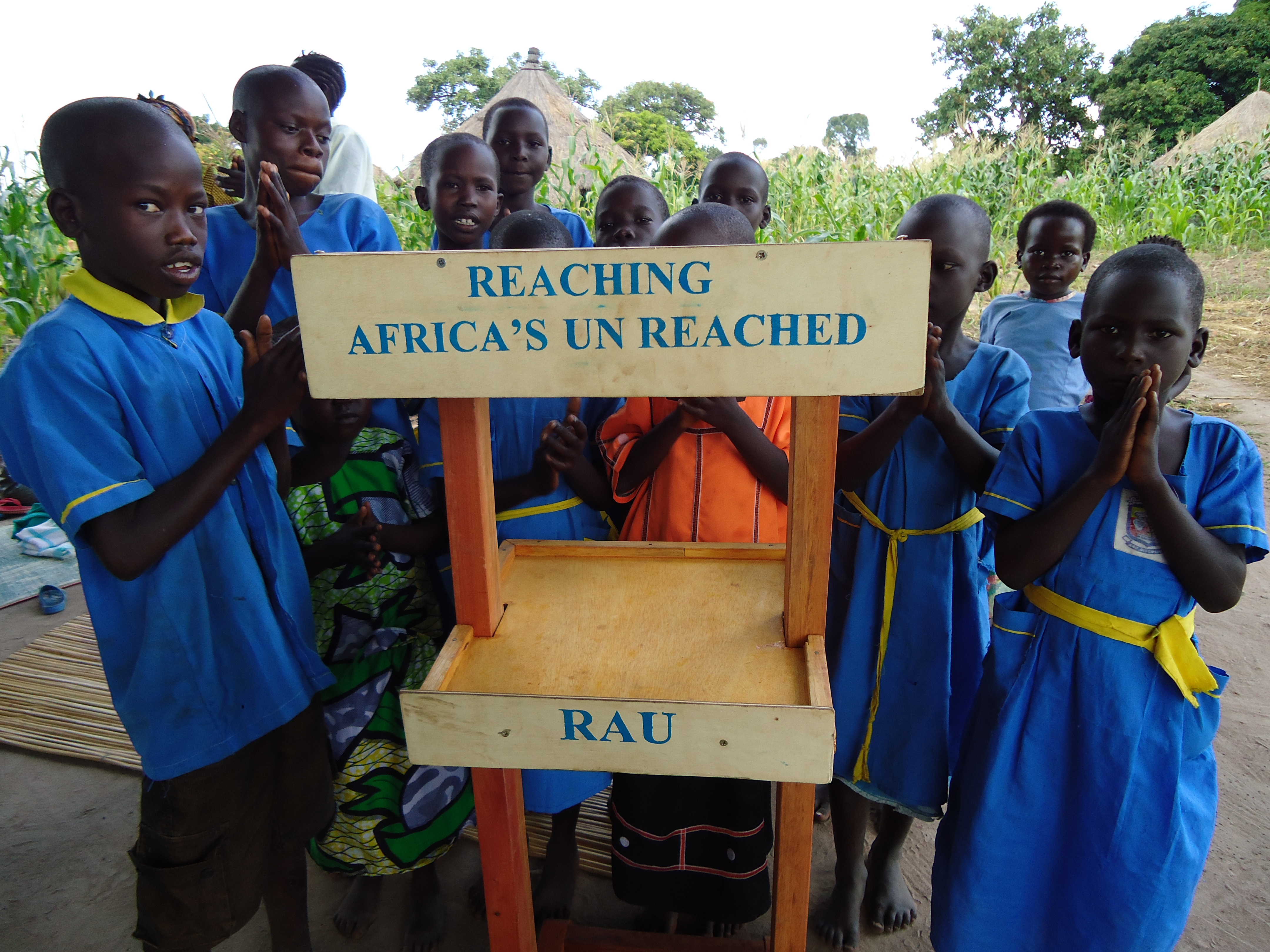
Thank you for all your prayers and support on behalf of Reaching Africa’s Unreached!

Most likely you have heard the news reports that a small group of American soldiers have been sent to Northern Uganda with more following in South Sudan and Northeastern Democratic Republic of Congo to help those governments eliminate the “The Lord’s Resistance Army”. Don’t let the name “Lord’s Resistance Army” fool you. This group is definitely not Christian. Their cultic leader, Joseph Kony, could rightly be called the “Hitler of Africa”! They have been committing horrible atrocities in North Uganda, South Sudan, Northeastern Democratic Republic of Congo for nearly two decades. In my travels there I have heard many heartbreaking personal stories. This short article, Taking on Uganda’s elusive Lord’s Resistance Army, with its related links will help inform you about this evil group and its leader Joseph Kony.

Please continue to pray for Carol and me as we seek to move to R.A.U.’s land. It is only through the proclamation of the gospel, discipleship, and Christ-centered mercy ministries that true and lasting healing/restoration can be brought to this region of the world. It is our heart desire to be physically there to be a part of God’s great work. We cannot make our permanent move until the R.A.U. Guesthouse is built.The slab is complete :-)! Please pray for our move and prayerfully consider helping us financially. Thank you!


“Expect great things from God; attempt great things for God”
  (William Carey)

Jacob Lee

Teaching the faithful that they may teach others (2 Timothy 2:2) !

South Sudan is now an Independent Nation

May the gospel go forth in this new nation. What an honor it is to be a part of what God is doing in this new nation!

From BBC News:South Sudan becomes an independent nation

Celebrations in Juba. 8 July 2011 The new state is rich in oil, but also one of the world’s least developed countries

South Sudan has become the world’s newest nation, the climax of a process made possible by the 2005 peace deal that ended a long and bloody civil war.

Sudan’s President Omar al-Bashir and UN Secretary General Ban Ki-moon are among international dignitaries attending celebrations in the capital, Juba.

Sudan earlier became the first state to officially recognise its new neighbour.

The south’s independence follows decades of conflict with the north in which some 1.5 million people died.

Celebrations in Juba began at midnight (2100 GMT). A countdown clock in the city centre reached zero and the new national anthem was played on television.

South Sudan became the 193rd country recognised by the UN and the 54th UN member state in Africa.

Officials had planned for people to hold quiet celebrations at home, with the formal declaration of independence due later on Saturday.

But the people clearly couldn’t wait. Two hours before midnight and lines of cars zoomed around town packed with people waving flags and waiting to celebrate.

When the final countdown arrived, the atmosphere was wild. Groups ran down roads, dancing to drum beats. Soldiers and policemen joined in too, waving paper flags and laughing.

A sign read: “Congratulations, free at last, South Sudan.” But the people didn’t need to read the message – they were already dancing and leaping with happiness.

“It is a shout of freedom,” said Alfred Tut, lifting his head back and screaming.

The BBC’s Will Ross in Juba says the new country’s problems are being put aside for the night, and there is an air of great jubilation.

People are in the streets, cheering, waving South Sudan flags, banging drums and chanting the name of President Salva Kiir Mayardit, he adds.

A formal independence ceremony is due to be held later on Saturday.

The Speaker of the South Sudan Legislative Assembly, James Wani Igga, is expected to read out the Proclamation of the Independence of South Sudan at 1145 (0845 GMT). Minutes later Sudan’s national flag will be lowered and the new flag of South Sudan will be raised.

In addition to Mr Bashir and Mr Ban, attendees will include former US Secretary of State Colin Powell, the US permanent representative to the UN, Susan Rice, and the head of the US military’s Africa Command, Gen Carter Ham.

Under the Comprehensive Peace Agreement, a referendum was held on independence, which was favoured by more than 99% of voters.

The new country is rich in oil, but one of the least developed countries in the world, where one in seven children dies before the age of five.

Unresolved disputes between the north and south, particularly over the new border, have also raised the possibility of renewed conflict.

On Friday, Sudan’s Minister of Presidential Affairs, Bakri Hassan Saleh, announced that it recognised “the Republic of South Sudan as an independent state, according to the borders existing on 1 January 1956”, when Sudan gained independence from Britain.


South Sudan

Facts and figures:

  • Population: 7.5-9.7 million
  • Size: 619,745 sq km (239,285 sq miles), larger than Spain and Portugal combined
  • Major languages: English, Arabic (both official), Juba Arabic, Dinka
  • Religion: Traditional and a Christian minority
  • Main export: Oil

Challenges ahead:

  • One of world’s least developed countries: Worst maternal mortality rate; most children below 13 not in school; 84% of women are illiterate
  • Relations with Sudan: Dividing debts and oil; border disputes; citizenship
  • Security: At least seven active rebel groups

‘Southern brothers’

President Bashir, who agreed the 2005 peace deal with the Sudan People’s Liberation Army (SPLA), stressed his country’s “readiness to work with our southern brothers and help them set up their state so that, God willing, this state will be stable and develop”.

“The co-operation between us will be excellent, particularly when it comes to marking and preserving the border so there is a movement of citizens and goods via this border,” he told journalists in Khartoum.

Fears of fresh conflict resurfaced after recent fighting in two border areas, Abyei and South Kordofan, which forced some 170,000 people from their homes.

But separate deals – and the withdrawal of rival forces from the border – have calmed tensions.

The UN Security Council has passed a resolution approving a new 7,000-strong peacekeeping force for South Sudan – but this is basically a rebranding of the force which was already in Sudan, mostly in the south.

Khartoum has said its mandate would not be renewed, leading the US to argue that the 1,000 UN troops should be allowed to remain in South Kordofan. The 1,000 troops in the disputed town of Abyei are to be replaced by 4,200 Ethiopian soldiers.

Our correspondent says keeping both the north and the south stable long after the celebratory parties have ended will be a mighty challenge.

Click to play

All you need to know about South Sudan’s independence

The two sides must still decide on issues such as drawing up the new border and how to divide Sudan’s debts and oil wealth.

Analysts say the priority for Khartoum will be to negotiate a favourable deal on oil revenue, as most oilfields lie in the south. At present, the revenues are being shared equally.

Khartoum has some leverage, as most of the oil pipelines flow north to Port Sudan on the Red Sea.

Citizenship is also a key issue which has not yet been decided.

A new law passed by the National Assembly in Khartoum has withdrawn Sudanese citizenship from all southerners.

The UN refugee agency (UNCHR), has urged both governments to prevent statelessness.

Sudan: A country divided

Satellite image showing geography of Sudan, source: Nasa The great divide across Sudan is visible even from space, as this Nasa satellite image shows. The northern states are a blanket of desert, broken only by the fertile Nile corridor. South Sudan is covered by green swathes of grassland, swamps and tropical fo

Freeing the Black Jihad Slaves in Sudan

Lord, please have mercy on those enslaved in Sudan. Please use Reaching Africa’s Unreached and others to help free those physically enslaved in Sudan. Help us pray as you instruct us in Hebrews 13:3, “Remember those who are in prison, as though in prison with them, and those mistreated, since you are also in the body.”
 
Lord, help us to passionately proclaim the liberating message of the gospel of Lord Jesus Christ…the gospel which has the power to break the chains of sin and Satan! You Lord are the one who gives liberty to the captives and sets free those who are oppressed. (Luke 4:18-19).
 
Help Reaching Africa’s Unreached testify to the power of the gospel both through our actions and our words. Help us to bear witness to Jesus Christ who changes the world! Help us spread the fame of His Name that He would be worshiped and adored where He is not known!
 
In Jesus Name!
 
———————————————————————–
 

Freeing the Black Jihad Slaves in Sudan

Posted by Charles Jacobs and Sasha Giller Dec 22nd 2010 at 5:49 am

Abuk Ngor Anyuon and Akuc Kiir Deng

If you think that enslaving blacks ended in the 19th century, you are dead wrong. Last week 603 black women and children were freed from the horrors of chattel slavery that to this day exists in Sudan, Africa’s largest country. Christian Solidarity International USA, a Christian human rights organization, frees slaves in Sudan. The stories the freed slaves tell them are simply horrific.

Abuk Ngor Anyuon was forcibly converted to Islam; her genitalia mutilated. Two of her sons were sold off to another master and her finger was cut off. Akuc Kiir Deng also accepted Islam under the threat of death. Akuc was blinded and ritually circumcised, and two of her children were taken from her. Akuot Anei Wol, freed last September, recollects: “I lost my sight in my eye soon after I was captured. I was still just a girl then. My master’s wife was called Howah. She made me grind grain and clean the house. One day, she was angry and accused me of failing to wash the dishes and sweep the floor properly. Howah grabbed a horse whip and struck me in the face. It hit me in the eye. I lost sight immediately. Howah said: “I’ll blind your other eye if you don’t work.”

Slavery in Sudan, a centuries-old phenomenon, gained widespread publicity in the United States in the 90’s. At that time an Arab regime in the Northern Sudan declared a “holy war” (jihad) against the African population of the South, which is largely Christian and animist. Arab militias, sponsored by the government and often joined by the Sudanese army, raided hundreds of villages, executing the men and taking women and children into slavery in the North. Unlike in the American South, slave owners in Sudan do not need the muscles of men to work plantations: they use boys as goat herds, and women for sex and for their wombs, to produce children who will be Muslims.

When confronted with facts of modern-day enslavement of blacks in the 1990’s, many Americans joined the neo-abolitionist movement spearheaded by groups like CSI in Europe and our own American Anti-Slavery Group. Some donated and raised funds to free Sudanese slaves; others participated in demonstrations and lobbied politicians. CSI’s emancipation operations were extensively covered by the media. The movement’s efforts bore fruit when the US-brokered Comprehensive Peace Agreement (CPA) forced the suspension of the slave raids in 2005.

As a consequence, Americans’ interest in Sudanese slaves decreased. Today, when up to 35,000 of blacks are still enslaved by the Arabs in the North, the media has fallen silent on the issue. Human rights giants like Human Rights Watch, which were never particularly helpful, also abandoned these slaves: a simple search of HRW’s website for “Sudan slavery” reveals that its most recent related report dates back to 2003.

As Sudan approaches January 9, 2011 – the day the Southerners are scheduled to vote to remain with the North or to secede – the chances to emancipate those still in bondage become increasingly smaller. Most experts believe the South will vote for independence. No one can predict the Muslim reaction in the North to the South’s choice of freedom. There is the possibility of revenge attacks and acts of violence against the slaves and other Southerners living in the North. Some even think the North-South war might be rekindled.

Yesterday The New York Times reported on a speech given by Sudan’s President Omar Hassan Al-Bashir, an indicted war criminal, who promised to impose Islamic Law (Shariah) in the North in case separation. “Shariah and Islam will be the main source for the Constitution, Islam the official religion and Arabic the official language,” he said. Al-Bashir also indicated that in his future state there will be no protection for non-Arab, non-Muslim minorities: “If South Sudan secedes, we will change the Constitution, and at that time there will be no time to speak of diversity of culture and ethnicity.” Interestingly, The New York Times “forgot” to report on his recent statement reflective of the state he envisions. Commenting on the popular YouTube video that shows a woman being flogged in public by the police, Al Bashir said: “If she is lashed according to Shariah law, there is no investigation. Why are some people ashamed? This is Shariah.”

CSI and the AASG are determined to liberate as many slaves as possible before the referendum takes place.

To learn how you can help visit www.iabolish.org.

——————–
See also:
 

Genocide in Sudan

and

THE SCOURGE OF MUSLIM SLAVERY


THE REST OF THE STORY