Great Discussion on Money, Materialism, and Missions!
“Be ready in season and out of season”!
Great Discussion on Money, Materialism, and Missions!

“Be ready in season and out of season”!
Here is a video Philip Estrada did for Reaching Africa’s Unreached. He is a very gifted man! He compiled this from hundreds of pictures and numerous short videos which were taken in Africa during my last trip. Thank you Philip and thank you Proclamation Hill Productions!
I cannot speak to highly of The Gospel Coalition Theological Famine Relief ministry. I had a very encouraging talk with Bill Walsh who is heading up this International Outreach. I look forward to working together with them for many,many years! Please pray for them and consider giving to them so that they can continue to spread biblical encouragement through the printed page. Thank you!
—-
Theological Famine Relief and How You Can Join In the Cause

“The printed [and digital] page is a missionary that can go anywhere and do so at minimum cost. It enters closed lands and reaches all strata of society. It does not grow weary. It needs no furlough. It lives longer than any missionary. It never gets ill. It penetrates through the mind to the heart and conscience. It has and is producing results everywhere. It has often lain dormant yet retained its life and bloomed years later.” (Samuel Zwemer)
Imagine being a pastor or elder of a small church in Africa, Asia, or South America. You have not been to seminary. In fact, formal schooling will not likely ever be within reach. You have little access to theological training or books. Internet is very limited, and when you do get access, download speeds are often prohibitive. And yet, you are responsible for feeding and leading your local church. This is the situation for thousands of church leaders in many regions of the world.
Theological Famine
Famine relief usually refers to an organized effort to reduce starvation. Relief efforts are put into place when an undernourished people group is suffering from a lack of vital nutrition. Although The Gospel Coalition has been working hard since 2007 to resource the North American church–which now has a glut of Christian resources–we realize that much more needs to be done to serve the rest of the world. The statistics are staggering for the theological famine–or lack of theological resources–that the rest of the world endures. The relief work will require overcoming language and cultural barriers, false teaching, lack of education, poor infrastructure, and poverty.
Our Vision
As God directs and equips, The Gospel Coalition’s international mission is to see thousands of congregations in Asia, Africa, South America, and Europe receive solid biblical teaching from their leaders, because of new access to theological resources, both physical and digital, in helpful languages and formats.
We are working to connect a network and movement of partnering individuals and organizations who, in the midst of theological famine, are mobilizing to bring relief. By God’s grace, we see church-planters, pastors, teachers, and missionaries around the world becoming strengthened by the power of the Gospel, through donations of biblical resources, for the building up of the church worldwide.
Relief Projects

The focus of our work is in launching Relief Projects consisting of physical and digital resources in English, Spanish, Russian, French, and other languages. The scope of the need is larger than any single ministry can fill. We are looking for partners to help us cultivate relationships, develop and deliver resources, mobilize networks, and build support. We want to connect with donors, churches, translators, publishers, missions senders, and goers who sense a call to engage in Theological Famine Relief. You can help us to create and deploy these resources where they are most needed around the world.
International Outreach was born under the ministry of Desiring God. During its first 6 years, the Lord enabled us to spread more than 360,000 resources through our partners to 113 countries. Join us in praying that He will enable us to reach even more through this relief effort in the coming years.
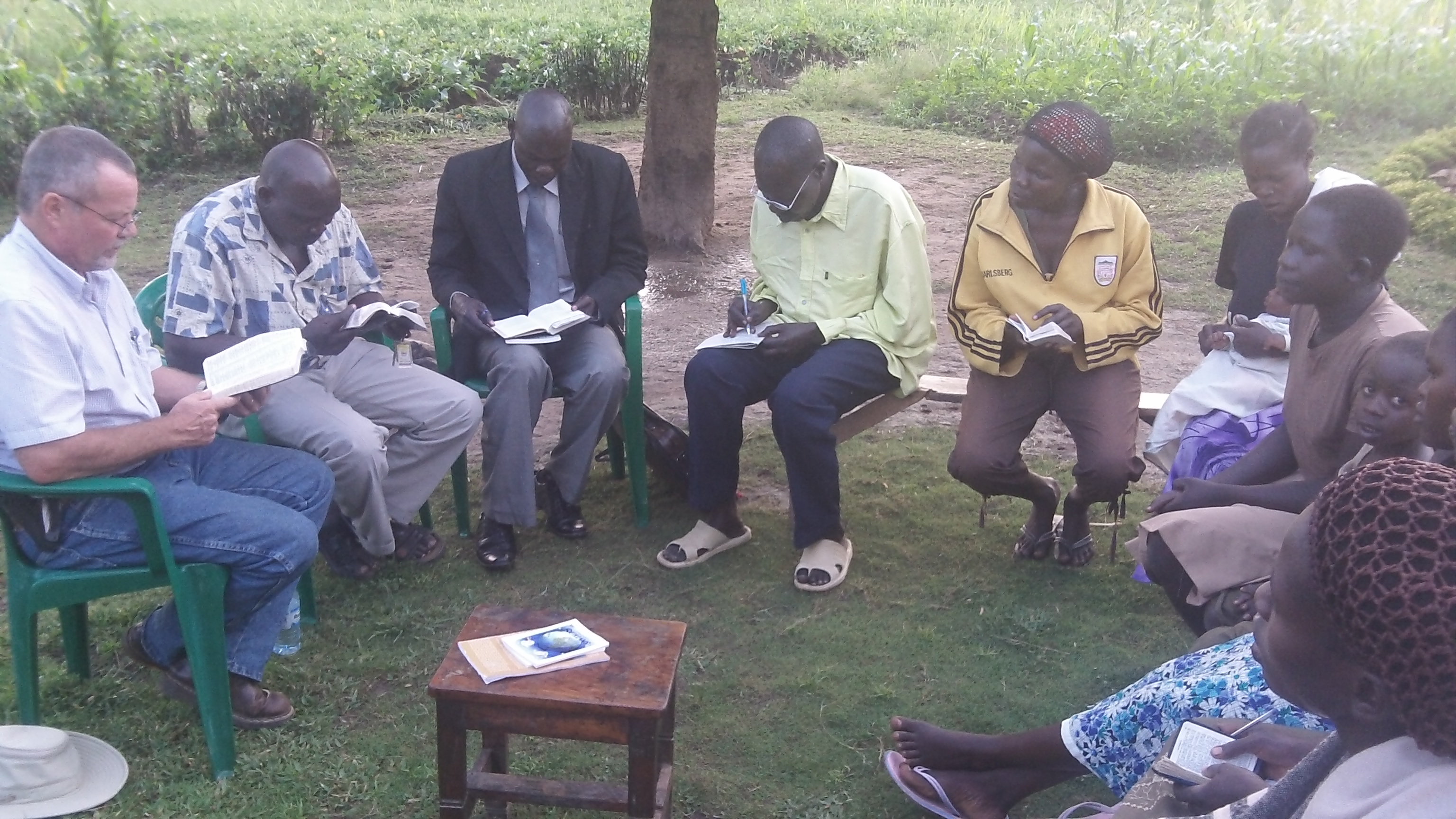
This post by Mike Bullmore states beautifully what Reaching Africa’s Unreached is seeking to do throughout North Uganda, South Sudan, Northeastern Democratic Republic of Congo, and regions further north. Please continue in your prayers for us!
“And the [instructions] which you have heard from me along with many witnesses, transmit and entrust [as a deposit] to reliable and faithful men who will be competent and qualified to teach others also.” 2 Timothy 2:2 (AMP Version)
——
“What’s wrong with that?” you ask. It actually sounds fairly biblical, almost Pauline. “I just want to finish the race. I don’t want to be disqualified. I want to be found faithful to the end.” Which is well and good, except if the understanding of faithfulness to the gospel is limited to and concerned only with my allotted three score years and ten, or if by reason of strength, four score.
I don’t know about you, but with the challenges and weight of pastoral ministry, sometimes I can be reduced to “Lord, just help me to be faithful to the end.”
And on the flipside of that temptation is the simple fact that it is very hard to be passionate about, and to maintain passion for, the future, especially if that future is beyond our sight. It is easy for me to be passionate about my children’s well-being. And it is easy to extend that passion to their children. But for how many generations out can you maintain that passion? For me it’s hard to go much beyond three generations without falling into abstraction.
I share that simply to illustrate that there is a difficulty, even in our understanding of something as good as gospel faithfulness, in holding the future clearly and rightly in our minds. This can contribute to a tendency to define faithfulness to the gospel too much in terms of our own tenure.
Let me state my point positively: Necessary to our faithful gospel ministry is an investment in the gospel ministry that will come after ours. I see this laid out in the first two chapters of 2 Timothy.
Paul says in 2 Timothy 1:14, “Guard the good deposit entrusted to you.” Then, a few verses later, picking up some of that same language, he tells Timothy, as part of his “guarding,” to “entrust to faithful men” what has been entrusted to him, and part of that “entrusting” is teaching them to pass the same thing on to others (2 Timothy 2:2).
Paul is telling Timothy that an essential part of faithful gospel ministry is this investment in the next generation. It is not some optional add-on. In other words, when Paul tells Timothy to “guard” the gospel, he is not just calling Timothy to protect the integrity of the gospel from the effects of false teaching. He is also calling Timothy to fight to preserve the continuation of the gospel against the effects of erosion over time, even beyond Timothy’s time.
So let me say it again. Essential to our faithfulness in gospel ministry is this investment in a succeeding generation of gospel ministers.
I believe the greatest challenge to this is what we might call the “my lifetime” tendency, a tendency we see exemplified in a certain Old Testament Israelite king. Perhaps you remember the story. Hezekiah is king of Judah. Sennacherib, the king of Assyrian, comes to attack. Hezekiah, with Isaiah’s help, prays and prevails. Hezekiah gets sick and is instructed by Isaiah to get his house in order. Hezekiah cries out to God and is granted fifteen more years. Upon hearing of this, the king of Babylon sends envoys, ostensibly to congratulate Hezekiah on his recovery. Hezekiah in his dim-witted pride shows off the national treasures. The envoys return to Babylon. Isaiah asks for a report of their visit. Hezekiah tells Isaiah what he did. In response, Isaiah predicts the coming Babylonian captivity. Then this.
Then said Hezekiah to Isaiah, “The word of the Lord that you have spoken is good.” For he thought, “There will be peace and security in my lifetime.”
What makes this account even more compelling and sobering as a warning to us is the fact that Hezekiah was extremely influential in reforming the spiritual life of Judah: cleansing the temple; restoring temple worship; reinstating Passover; reorganizing the priesthood. See the account in 2 Chronicles. He made an impressive contribution along very important lines.
But then there is this episode late in his life which betrays both his pride and his myopia. Despite all his zeal, there was, apparently, an absence of zeal for what happened after he passed off the scene.
Richard Baxter brings a wonderful way of addressing this in his book The Reformed Pastor. He writes, “If you will glorify God in your lives, you must be chiefly intent upon the public good, and the spreading of the gospel through the world.” The alternative, according to Baxter, was “a private, narrow soul always taken up about itself that sees not how things go in the world. Its desires and prayers and endeavors go no further than they can see or travel.”
Baxter is talking about the possibility of a geographical shortsightedness, but we might also be guilty of a temporal shortsightedness. That was Hezekiah’s case.
Baxter called his readers to just the opposite — a largeness of soul that “beholds all the earth and desires to know how it goes with the cause and with the servants of the Lord.” Paul’s words in 2 Timothy call us to the very same thing but looking out into the future. “How will it go with the cause? And what can I do to fuel this cause into the future?”
Let us not be content to simply say, “As long as all is well in my lifetime.”
In contrast to Hezekiah’s myopia, we see Paul’s far-seeing vision, and it becomes especially poignant in view of Paul’s imminent departure. Remember this is the same letter in which he says, “The time of my departure is at hand.”
So now he’s asking Timothy to think a certain way about gospel ministry. And he’s asking Timothy to train the next generation to think this way about gospel ministry. And God is asking us to think this way about gospel ministry. Necessary to faithful gospel ministry is an investment in the next generation of gospel ministers.
This should translate into very concrete realities in our weekly lives. This is a responsibility the church shares corporately, but it will require of you a very definite investment of time, energy and purpose.
What will this look like? Let me suggest four possibilities. First, devote yourself to faithful gospel ministry, especially the ministry of the word. The best way to train men to faithfully preach the gospel is to faithfully preach the gospel. William Perkins wrote, “So, let every minister both in his teaching and in his conversation work in such a way that he honors his calling, so that he may attract others to share his love for it.”
Second, pay attention to the young men of various ages in your congregation. Notice how they receive your preaching. Notice how they process your preaching. Notice any deepening affections for God and his word. Keep your eyes open.
Third, create contexts for the young men who catch your eye to practice and grow in their handling of the word.
Fourth, and this must not go unsaid, pray very specifically for God to raise up the next generation of gospel ministers. Pray for your replacement, but pray also for more than that. Pray with an eye, and a heart, toward the future and the continuing success of the gospel in the world, until Christ comes.
This article was posted here: http://www.desiringgod.org/blog/posts/brothers-train-up-the-next-generation

“And Jesus came and said to them, “All authority in heaven and on earth has been given to me. Go therefore and make disciples of all nations, baptizing them in the name of the Father and of the Son and of the Holy Spirit, teaching them to observe all that I have commanded you. And behold, I am with you always, to the end of the age.”
(Matthew 28:18-20 ESV)
I am very grateful for a godly wife who also has a passion to spread the fame of King Jesus where He is not known. She is my best friend and the love of my life! Below she shares her heart in our pursuit to live out our lives in this region of the world for God’s glory.
Moyo 2013—or BUST!
By Carol Lee
I have been thinking about writing what’s on my heart for quite some time, but it wasn’t until recently that I saw how important it was to do so. So many people have expressed concerns and questions that deserve an accounting. This will also, I hope, be more than an accounting—a call to boldness and a change in priorities and focus.
My hope is that in writing, I will answer these questions about our going to Africa:
1) Where does Carol stand on this plan? We know Jacob is “gung-ho”, but what about Carol?
2) Aren’t you going to miss your family? Aren’t you giving up too much?
3) Isn’t it dangerous? And why can’t you just send money and resources instead of exposing yourself to danger?
Question One: Is Carol on board?—YES!!
For me, it has not been so much a question of whether or not we should or should not go, but when and where. The general commission to every believer from Christ Himself is bold and clear and it has always been a part of my understanding of the “normal” Christian life—that is, to be sent out, or at least to have some sense of mission as you live life, whether it is here or abroad. But, I have always had a special “amen” in my heart to missions abroad.
After all, I am the grandchild of Henry and Frieda Mayer and the child of Joel and Lillian Mayer, all Lutheran Missionaries to India! I was born there and lived there until I turned 18, when I returned to the U.S. to go to college. I met Jacob here in Seguin. He was actively living out a mission-directed life. We married within 9 months of meeting. Jacob and I had every intention of spending our lives as missionaries to India. We moved there six months after we were married (with me being pregnant with our firstborn, Joshua). We sold or gave away almost everything, packed up and moved. If we had been able to get visas and the continued support of a local church or mission board, we probably would have stayed there indefinitely. When we returned to the States, we became very involved in our church, Lifegate, which also had a love for and support of missionaries. “Missions” had been an integral and “normal” part of our lives and priorities and interests.
Only as we look back (with 20/20 vision) can we see the wise, Fatherly plan in keeping us here all these years—maturity, growth in our understanding and experience of the local church and the importance of being sent and supported, not only financially, but in prayer and love and partnership. In the interim of 31 years, we have raised three wonderful children (absolutely by the grace of God) and have become grandparents. Our experience here in Seguin, in the context of our local church, Lifegate, has been service and use of our gifts, growth in depth of understanding of and obedience to God’s Word, friendship and family love and now, very importantly, Lifegate’s very enthusiastic sending of us to Africa, which has been a stretching experience for the whole church.
There is no doubt that Jacob’s vision and passion is the “spearhead” of our being sent out (sharp, weighty, poised and ready). The specific calling upon Jacob’s life is unequivocal. His passionate pursuit of preaching and living out the Gospel in mission in Africa and his constancy in pursuing it are the fruit of seeds God planted in his heart from the very moments after his conversion. And, it seems to me, this has been widely recognized by all who look on, including and especially me. To a large degree, because Jacob is called, so am I. Wherever he goes, I go; wherever he stays, I stay; and his God is my God! But, of course, it is more than that.
Question Two: Aren’t we giving up too much (i.e. family, comforts and all)?
We are in an intense tug-of-war in our hearts between the “foolishness” of leaving houses or brothers or sisters or father or mother or children or lands, as Jesus said in Matthew 19:29, and the accepted cultural norm and ideal of safety/comfort/convenience. Three decades of living in the glorious “bubble” of the American dream has ensured that this foolish “leaving” business would not be an easy commandment to obey. We are giving up much, and it will be painful and difficult!
It’s amazing what we can assent to in our heads that has no true bearing on our hearts until God’s convicting and calling in a particular decision or direction becomes real and personal. Then we are truly tested as to what we believe. God has, through His word and through His people, and through experience, been preparing me all along to come to terms with and be gripped by the truth that being a disciple of Christ involves cross-bearing, leaving family, hardship and suffering, as well as great joy and comradeship in Christ and with Christ, and the hope of glory. It has only been recently, though, that this truth has become beautiful to me that God actually has a design and plan for our suffering as we are obedient to “GO!”
John Piper’s “Live to Die” sermon ( http://www.desiringgod.org/resource-library/conference-messages/live-to-die ) has been most instrumental in exposing my fears, my unbelief and my lack of perspective. With the precision and healing of a surgeon’s knife, his message has cut into my trusting in and clinging to earthly security, comfort and pleasure. His message has transplanted in me a heart that can see and delight in something far superior: the worth and glory of God. We have an awesome privilege in being called children of God. Our Savior suffered and was inconvenienced and left the glory of heaven to become like us in every way. So now, through His death, resurrection and ascension we are able to participate in His glory and His joy!
Piper calls us to a radical obedience with a readiness to suffer and “to take risks that would look foolish and be foolish if there were no resurrection from the dead.” He talks of embracing suffering as a strategy and that God has a design and a purpose in suffering as we take the message of salvation to those for whom Christ died.
“For it was fitting that He, for whom and by whom all things exist, in bringing many sons to glory, should make the founder of their salvation perfect through suffering.” (Hebrews 2:10, ESV)
“looking to Jesus, the founder and perfecter of our faith, who for the joy that was set before Him endured the cross, despising the shame, and is seated at the right hand of the throne of God.” (Hebrews 12: 2, ESV)
No suffering is “worth it” unless we can see something on the other side of it that is of greater value than the suffering itself. This carries over into so many things: an athlete who suffers through training to win the race, a dieter who suffers through the denial of craving to shed those excess pounds, the parent who sees through to the other side of daily discipline and tedious and persistent training to the joy of the peaceful fruit of righteousness in his child. God does not ask us to suffer for no reason, but for the joy of displaying Christ and watching Him do His redemptive work in the lives of those we want to reach.
“If in Christ we have hope in this life only, we are of all people most to be pitied.” (I Corinthians 15:19, ESV)
“So we do not lose heart. Though our outer self is wasting away, our inner self is being renewed day by day. For this light momentary affliction is preparing for us an eternal weight of glory beyond all comparison, as we look not to the things that are seen but to the things that are unseen. For the things that are seen are transient, but the things that are unseen are eternal.” (II Corinthians 4: 16-18, ESV)
Another truth which John Piper’s message helped me see and treasure comes from Colossians 1:24-29, “Now I rejoice in my sufferings for your sake, and in my flesh I am filling up what is lacking in Christ’s afflictions for the sake of His body, that is, the church….” John Piper explains that passage in this way: Christ suffered affliction in bringing His salvation to us. Jesus is no longer present on the earth except through the Church, His body. The delivery of Christ’s saving message in person to those for whom Jesus paid the price will bring us afflictions in various forms and degrees, but we can rejoice in those afflictions because He has chosen His love for us to be most greatly displayed in His suffering on our behalf and when we suffer great and small things in order to bring that love to others.
I was asked the question, “Why can’t you just send money and resources over there? Why do you have to go to someplace that is dangerous for you?” My answer to that question finds its confidence in this truth: “Jesus made a joyful offering for the world and wants that offering delivered in person—or embodied!” (John Piper, “Live to Die”) It’s not hard to understand; anyone of us would rather receive love in person than merely in a letter or some gift. We don’t expect our children to learn all about life from a manual. There is no more effective way to produce godliness in our children than when we embody the truth, and teach the truth as we walk alongside of our children. That is how God means for us to teach and reach the world. And in doing so, we will encounter suffering in various forms.
So, am I a masochist? NO! I have no death wish or a desire to suffer. I am, by nature, a wimp. I love my creature comforts; I love our family (both biological and spiritual). I love being able to do things conveniently and at my whim and in the safety and orderliness of America! BUT…I am learning to love the command of Christ and the glory of Christ more! We really do feel it, Jacob and I…the pending pain of separation from family and friends, the loss of comforts, the potential of danger and the worst that our imaginations can offer us! Thanks be to God for that phrase, “for the joy set before Him!” Because of that we can see over our suffering to a greater weight of glory beyond all comparison—the bringing of many sons to glory.
This is an on-going transformation of my thinking and perspective…a work in progress! And it’s not a haphazard transformation, but something I am doing intentionally.
1Peter 4:1-2 states, “Since therefore Christ suffered in the flesh, arm yourselves with the same way of thinking, for whoever has suffered in the flesh has ceased from sin, so as to live for the rest of the time in the flesh no longer for human passions but for the will of God.”
Having the right kind of thinking…taking every thought captive…is not a playful exercise, but a strategy of war. I want God’s thoughts to win in my mind and I want His truth to shape my feelings and hopes and confidence. Right now I am listening my way through sermons ( http://www.desiringgod.org/ ) that John Piper has preached on Suffering, Courage and Boldness, and the Mission of the Church. I am reading stories of fellow Christians who have, for the joy set before them, endured some kind of cross or other. It helps me see how God will come through for me, not now, as I imagine suffering or trials, but then, when I am actually going through them. It builds faith in me to trust God for future grace.
I sincerely hope that what I have written will not only answer your questions, but will challenge your own beliefs. I pray that it will embolden you to live courageously and joyfully—in a manner worthy of the calling you have received in Christ.
This word from Carol is very encouraging to me. I can testify that what she has written comes from the depths of her heart. Our discussions and prayers have been and are centered around our desire to know Christ and to make Him known, especially among those who do not have access to good news of Jesus life, death, resurrection and ascension!
Please continue to pray for us in this pursuit!